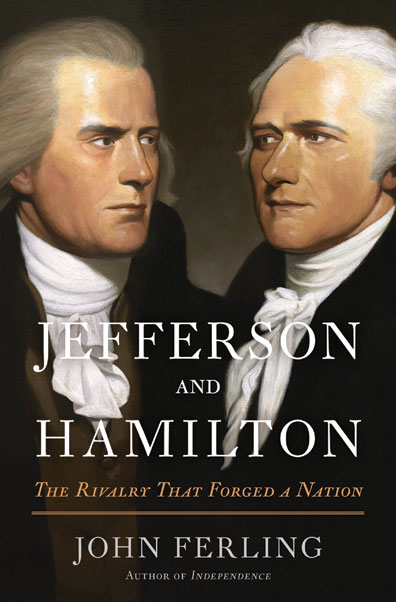
 Jefferson and Hamilton: The Rivalry That Forged a Nation. By John Ferling. Bloomsbury, 2013, 436 pp., $30.
There’s an old saying that the only new thing in the world is the history you don’t know. To the casual observer, the Tea Party that rose up in opposition to President Barack Obama’s policies in 2009 might seem to be a new phenomenon. But after reading John Ferling’s new book about Jefferson and Hamilton: The Rivalry That Forged a Nation, you realize that the Tea Party is nothing more than the latest iteration of a movement that goes back to our country’s founding.
Jefferson as a Tea Partier? Probably not. But the political strain they represent goes back to Jefferson’s earliest opposition to the nationalist policies of Alexander Hamilton in the 1790s.
What is the proper role of government in our lives? Americans have never been able to agree on the answer to that question, and it has bedeviled us since the Revolution. And what, after all, was the real legacy of the American Revolution? A strong central government that could properly govern and defend the states united while promoting business and trade, or a loose confederation of states that could look after their own affairs and where farmers and small landowners would flourish? This was the breeding ground for the dispute that began at the Constitutional Convention and that has continued from that day to this. What should government do and not do? What is an inalienable right? What is equal justice under the law? These three questions have run on parallel tracks through our national history from that day to this, and in trying to answer these questions Americans have created Democrats, Know Nothings, Republicans, Populists, labor unions, conservative think tanks, Progressives, Dixiecrats, and the Tea Party, among many other strains of the American body politic. It was the central reason for the rivalry between Jefferson and Hamilton as their personal disagreements hardened into institutionalized political parties as they argued over the true legacy of the American Revolution.
John Ferling is one of our country’s best historians of the American Revolution. He ranks right up there with David McCullough, Joseph Ellis, and Gordon Wood, and even a casual glance at their work will show you how much they’ve relied upon Ferling’s books in their own. Ferling wrote a biography of John Adams (University of Tennessee Press, 1992) nearly ten years before McCullough, and it’s every bit as worthy of the accolades that the latter received for his work, even if it didn’t inspire an HBO miniseries. Ferling’s literary output since 2000 is amazing: seven books in the last thirteen years, each an original and thought-provoking work on the founders and the founding era (and all except the last few written while he was teaching at the University of West Georgia). Chock full of graceful prose and penetrating analysis, they’re all worth reading, as is his biography of Washington, published in 1988.
There are many good comprehensive histories of the Revolution, but the best place to start, in my opinion, is two volumes by John Ferling. A Leap in the Dark: The Struggle to Create the American Republic (Oxford, 2003) is the best political history of the years 1750-1800. Ferling’s companion volume, Almost a Miracle: The American Victory in the War of Independence (Oxford, 2007) covers the military conflict, and—again, in my opinion—there is no better military history of the war available today. Here’s what I wrote on the flyleaf of the book when I finished it: “A first-rate book, the best one-volume history of the war to this point. Ferling’s best work yet. Probing analysis of leaders, campaigns, and issues on both sides. Its final summary chapter is the best account available of why the British lost and the Americans won, as is his summation of Washington.”
Among his other books is a prosopography (a Ferling-esque word; his books are scattered with words that you’ve never heard of, like persiflage, umbra, and lucubration) of Washington, Adams, and Jefferson (Setting the World Ablaze: Washington, Adams, Jefferson, and the American Revolution, Oxford, 2000); a study of the pivotal election of 1800 (Adams v. Jefferson: The Tumultuous Election of 1800, Oxford, 2004); a political history of George Washington (The Ascent of George Washington: The Hidden Political Genius of an American Icon, Bloomsbury, 2009); and Independence: The Struggle to Set America Free (Bloomsbury, 2011).
How, one might ask, does Ferling keep plowing the same ground and still have something new to say? Part of it is simply attributable to his maturity as a scholar. Unlike others who leap from one time period to another with each book, Ferling has spent his entire professional life laboring in the vineyard of the Founding era. Ferling isn’t just dabbling in this period; he knows it as well as anyone can who is now two centuries removed from the time about which he’s writing. He is well-versed in what the Founders wrote, what they read, what they believed, and what they hoped to achieve. But he’s not awe-struck by them. Simultaneously, his reflections on people and events have deepened with the years, as he himself has aged. As should happen as we grow older, his own insights about human nature reflect his growth as a human being; he’s more empathetic, more forgiving of human foibles and less harsh on their failures, though he isn’t afraid to point them out and to hold men and women accountable for not only what they achieve, but what they fail to achieve. He knows what it’s like to live life, make mistakes, and have regrets. It’s the primary reason why people in their 20s shouldn’t write biographies.
Alexander Hamilton is one of the great success stories in American history. He was born in the West Indies and grew up in poverty. His father abandoned the family early on and his mother died when he was 13. After coming to America and eventually joining the Continental Army, Hamilton served on Washington’s staff and witnessed and endured first-hand the hardships of war.
His outlook from the beginning was national; having no family, he never left the army on leave, never went home, and after suffering through the winter of 1778 at Valley Forge, he came to believe that the decentralized government created by the Articles of Confederation wasn’t fit for war or peace. How could any government worthy of the name leave the army that was fighting for its country’s independence starving, unpaid, and in rags? Put quite simply, the national government lacked not talent or leadership, but power. As Ferling puts it, “Fearing an oppressive central government, the states had overreacted [in the Articles of Confederation] and, in Hamilton’s opinion, had created a monster,” a government that was feeble, weak, and unable to pay its bills.
Hamilton proposed a new constitutional convention while he was still in the army in the early 1780s, though it wouldn’t happen till the famous gathering of demi-gods in 1787. Serving in Washington’s army shaped Hamilton’s worldview and his policies for the rest of his life and was the basis for his support of a strong central government and the economic policies that Jefferson despised.
Jefferson never served in the army and though it’s not fair to say he sat out the war, he certainly never experienced the privations and hardships of the soldiers in the Continental Army. His worldview was Virginia, which as Ferling fairly points out, had existed for 150 years when the Revolution began, and Jefferson’s roots there ran deep. It was perhaps only natural that Jefferson’s focus should remain there through most of the conflict, serving in the House of Burgesses and then as Virginia governor during a very difficult period. With the exception of one remarkable year in the Continental Congress when he penned the Declaration of Independence, Jefferson remained in Virginia throughout the war. His contemporaries and fellow Virginians from Richard Henry Lee to Washington himself pleaded with Jefferson to come down off the mountain and get involved in the conflict, but he always begged off, citing his wife’s precarious health or other domestic issues. He left himself wide open for criticism.
When they later became rivals in Washington’s cabinet, Hamilton always viewed Jefferson through the lens of Valley Forge—as did another Jefferson nemesis and Army veteran, John Marshall—and he could never understand how Jefferson could portray himself as the living embodiment of the American Revolution when he had spent that miserable winter and many others during the conflict snugly at home at Monticello. For his part, Jefferson viewed Hamilton as nothing more than an Anglo-phile immigrant upstart who never really understood the character of the American people and whose policies would enslave small farmers to stock jobbers and the monied elite.
The truth is, Jefferson never favored anything more than a revision of the Articles of Confederation; he was never in favor of a wholesale re-boot that Hamilton et al. pulled off in the Constitutional Convention. While serving in Washington’s cabinet, the two men demonized each other and framed their rival’s opinions as not just wrong but as a threat to the future of the republic itself. Sound familiar?
As Ferling puts it, “Hamilton’s vision was distinctly different from that of Jefferson. The Virginian’s emphasis had been on the preservation and expansion of the individual’s freedom and independence. Hamilton emphasized the well-being and strength of the nation.” Jefferson may not have spent time at Valley Forge, but his tenure in the diplomatic circles of monarchical Europe strengthened his faith in democracy and civil liberties that Hamilton never shared. Conversely, Hamilton trusted the capitalist marketplace and a strong military in a way that Jefferson loathed. Working out these differences would create the first two political parties, Hamilton’s Federalists and Jefferson’s Democratic-Republicans, which institutionalized their personal disagreements. Their political rupture split the country asunder in the 1790s and set America on the course it still follows right up through the latest round of budget negotiations between the two parties in Congress: what is the proper role and scope of the national government of the United States?
There are many good stories here, and Ferling tells them well: Hamilton’s on-and-off relationship with Washington, his affair with Maria Reynolds, and his fall from political grace during the election of 1800. His account of the Jefferson-Hemings story is balanced, and he presents the evidence (and its problems) about as fairly as one could wish.
Hamilton was of course killed in a duel by Aaron Burr during his rival Jefferson’s first presidential administration. By that time, with Jefferson and the Republicans in the ascendant, Hamilton was convinced that his political career was over and that all of his dreams for a strong central government that would preside over a thriving business community lay in ruins. Jefferson’s Arcadian vision had seemingly won the day and the hearts of the American people. If he had only known. We may still revere Jefferson’s championing of civil liberties and the freedom of the common man, but we live in Hamilton’s America, an economic and military colossus that sits astride the world.
During the recent debate over raising the debt ceiling, economists forecast that an American default would be catastrophic for the world’s economy. I think Hamilton would have been pleased that the American economic engine has become that powerful. And I think he’d still be fuming at small-government proponents who, as he said in describing Jefferson, would reduce the national government to “the skeleton of power” and bring on “national disunion, national insignificance, public disorder and discredit.” Humbug, Jefferson might reply.
Does it comfort us to realize that the problems that confound us as a country—national debt, the size and role of government, our commitment to democracy and civil liberties, and the promise and limits of market capitalism–baffled some of the best minds in American history? It suggests that we’ll never figure this out, that we can’t really ever lay these eternal arguments to rest. But it also reinforces the point that the American republic is an ongoing experiment in self-government. The founders didn’t give us a finished product, they gave us a framework, and each generation adds another layer. As we argue over gay marriage, debate immigration and the country’s changing demography, or spar over whether corporations have the same rights as individuals, we’re reminded daily that the rivalry that forged a nation—and the heartbeats of these two founding icons—still echoes after more than two centuries. As Abraham Lincoln said, our habit of argument is a mark of our liberty. A healthy and functioning democracy shouldn’t have it any other way.
 “Hey! Aren’t you the guy that does that history commercial every night on TV?”
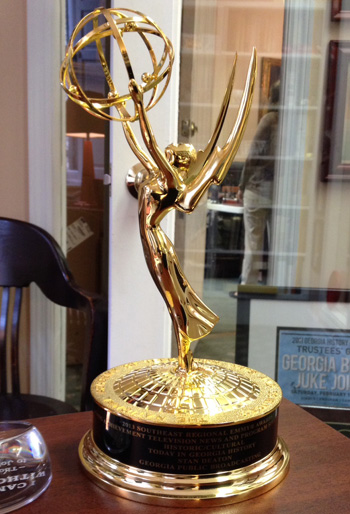 We proposed the idea of a short 1-2 minute daily radio program to Teya Ryan, President and Executive Director of Georgia Public Broadcasting, and she loved it. But, she asked, why limit it to radio? She saw the potential for something much bigger—radio yes, but let’s broadcast it on TV and internet as well, with illustrations, photographs, maps, and other graphics that flesh out each subject in a more meaningful way, and broadcast it across the state—and into Georgia classrooms—every day.