In this Dispatch, Dr. Deaton discusses General William Sherman’s Atlanta Campaign, which began 156 years ago this week in May 1864, and led to the fall of Atlanta, Lincoln’s re-election, the March to the Sea, and the end of the Confederacy.
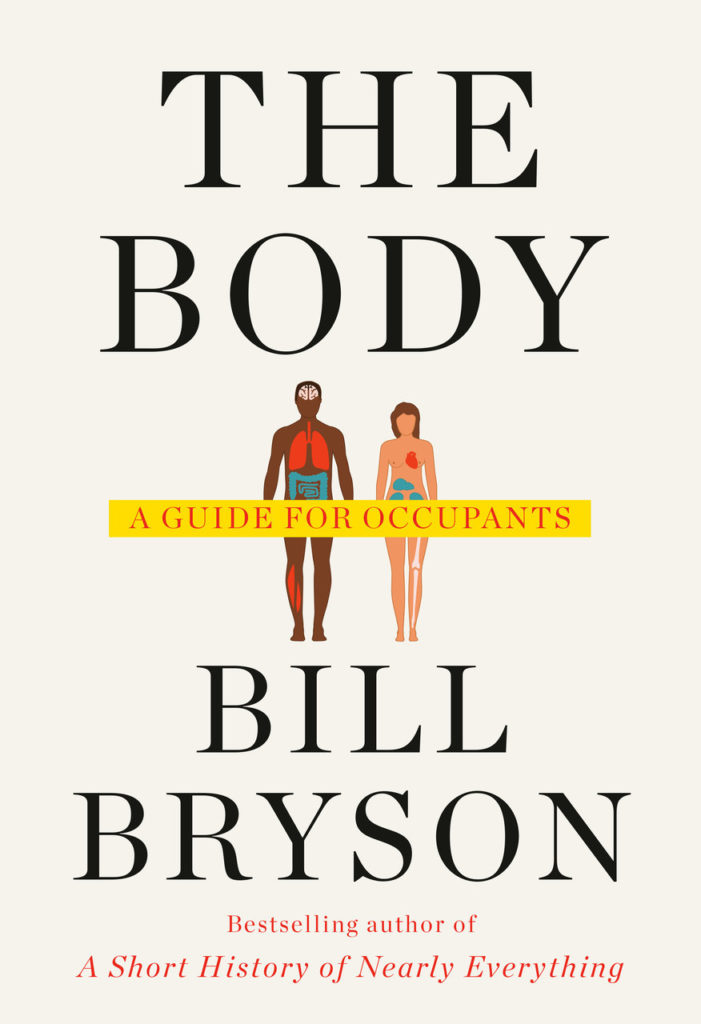
Bill Bryson, The Body: A Guide for Occupants (Doubleday, 2019, 450pp.)
During the last month to six weeks, as we’ve been sheltering in place, have you had more or less time to read? To watch and read the news, you’d think people had nothing but time on their hands.
I’ve been fortunate to be able to work from home, but that certainly hasn’t translated into more time to read. Like a lot of people, I find that I work longer hours now without the natural distance barrier between work and home.
Nevertheless, I have kept up the same reading schedule during this time. I read in the pre-dawn hours, and for me, those are still the best minutes of the day for focused, steady reading. It’s still and quiet, inside and out, and nothing else distracts me.
I just finished reading Bill Bryson’s new book, The Body. I first met Bryson, like a lot of other people, through his 1998 book, A Walk in the Woods: Rediscovering America on the Appalachian Trail. I was in the midst of hiking Georgia’s portion of the AT at that time, and Bryson’s book was just what I needed.
Naturally I had to go out and buy and read nearly everything else Bryson had written, before and since, which include:
The Lost Continent: Travels in Small-Town America (1989)
The Mother Tongue: English and How it Got That Way (1990)
Neither Here Nor There: Travels in Europe (1992)
Made in America: An Informal History of the English Language in the United States (1994)
Notes from a Small Island (1995, an American living in England)
I’m a Stranger Here Myself: Notes on Returning to America after Twenty-Five Years Away (1999)
In a Sunburned Country (2000, about Australia)
Bill Bryson’s African Diary (2002)
A Short History of Nearly Everything (2003)
The Life and Times of the Thunderbolt Kid: Travels Through My Childhood (2006)
Shakespeare: The World as Stage (2007)
Bryson’s Dictionary for Writers and Editors (2008)
At Home: A Short History of Private Life (2010)
One Summer: America, 1927 (2013)
The Road to Little Dribbling: Adventures of an American in Britain (2015)
Bryson holds dual American & British citizenship, giving him unique insight into both cultures, which he frequently shares with his readers. He has a very singular gift as a writer, the ability to be hilariously funny one moment and deadly serious the next, sometimes in the same book. And when he’s funny, he’s really funny.
For those keeping score, his travel books tend to be humorous (I’ve never forgotten his descriptions of “shitty-shoed rednecks” in The Lost Continent), while his explorations of language and science are usually serious, though not without their own comic asides.
His memoir of growing up in Iowa, The Life and Times of the Thunderbolt Kid, is one of the funniest books I’ve ever read, and I highly recommend it. Among autobiographies, it may not rank with, say, The Education of Henry Adams, or The Confessions of St. Augustine, but neither of those two, so far as we know, ever trained a white-hot beam of sunlight on their Uncle Dick’s bald spot with a magnifying glass while he was napping, as Bryson did in his youth.
[For the record, in 1989’s The Lost Continent, Bryson visited Savannah, pre-Midnight in the Garden of Good and Evil, and found it charming, if hot.]
Bryson’s new book, The Body, is equal parts enlightening, eye opening, and, at times, downright scary. For this liberal arts major that did abysmally in science and biology, it’s quite an education. What follows are some of its more fascinating factoids:
You blink 14,000 times a day, so much that your eyes are shut for 23 minutes every day.
Since you started reading this sentence, your body has produced a million red blood cells.
DNA is extremely stable and lasts for tens of thousand of years: “Probably nothing you own right now—no letter or piece of jewelry or treasured heirloom—will still exist a thousand years from now, but your DNA will almost certainly still be around and recoverable, if only someone could be bothered to look for it.”
“Even when you do nearly everything wrong, your body maintains and preserves you. Five out of every six smokers won’t get lung cancer. Most of the people who are prime candidates for heart attacks don’t get heart attacks. Every day, it has been estimated, between one and five of your cells turn cancerous, and your immune system captures and kills them. Think of that.”
“No one has ever come close to explaining why our fingers wrinkle when we have long baths.”
Viruses bide their time. In 2014 French scientists found a previously unknown virus in Siberia that had been locked in permafrost for 30,000 years but “when injected into an amoeba, it sprang into action with the lustiness of youth.”
Every bit of penicillin manufactured since 1943 has descended from mold growing on a single random cantaloupe bought by a lab assistant named Mary Hunt in Peoria, Illinois.
Because antibiotics have been overprescribed, the death rate for infectious diseases has been climbing and is now back to the level of the 1970s.
In 1848 in rural Vermont, a young railroad builder named Phineas Gage was packing dynamite into a rock when it exploded prematurely, shooting a 2-foot tamping rod through his left cheek and out the top of his head and landed 50 feet away. The rod removed a perfect core of his brain an inch in diameter. Gage survived and did not lose consciousness, though he lost his left eye and a suffered a changed personality. This was the first proof that physical damage to the brain could transform a person’s personality.
There is no end to conditions caused by brain disorders. Anton-Babinski syndrome is a condition in which people are blind but don’t believe it. Riddoch syndrome victims cannot see objects unless they are in motion. Capgras syndrome causes sufferers to be convinced that close friends and relatives are imposters. And with Cotard delusion, the victim believes they are dead and nothing can convince them otherwise.
There are people who have completely lost the ability to smell, known as anosmia. Even worse, some people suffer from something called cacosmia, where everything—everything—smells like feces. “It is, by all accounts, as horrible as you would imagine.”
You swallow about 2,000 times a day. Reading that probably made you swallow.
Choking is the fourth-most common cause of accidental death in America today.
The amount of heat in chilies is measured in units called Scovilles, named for Wilbur Scoville (1865-1942), who wrote an academic paper entitled “Some Observations on Glycerin Suppositories.”
“An easy way to experience the limitations of your taste buds is to close your eyes, pinch shut your nostrils, and eat a flavored jelly bean collected blindly from a bowl. You will instantly apprehend its sweetness, but you almost certainly won’t be able to identify its flavor.” You need your sense of smell to help you do that.
“The current generation of young people is forecast to be the first in recorded history not to live as long as their parents because of weight-related health issues.”
Just by standing, you can burn an extra 107 calories an hour.
Nicholas Alkemade, a British airman during World War II, leapt without a parachute from a burning plane that was 3 miles in the air. Pine tree branches broke his fall, and he landed unharmed in a snow bank, with only minor abrasions and a sore kneecap. He died peacefully in bed 43 years later. But the world’s record is a flight attendant who in 1972 fell 33,000 feet—6.1 miles—without a parachute when the plane she was in was blown apart in midair. She survived. “The human body, in short, can be a wonderfully resilient thing.”
The longest any human has held their breath is 24 minutes and 3 seconds.
Charles Osborn, an Iowa farmer, hiccupped continuously for 68 years. They started in 1922 when he tried to pick up a 350-pound hog and stopped in 1990, a year before he died.
Sleeping is the most mysterious thing we do. All parts of the body benefit from it. If you are deprived of it for long enough you will die, but why you die is a medical mystery. “As far as can be told, sleep does nothing for us that couldn’t equally be done while we were awake but resting.”
The longest anyone has intentionally gone without sleep is 11 days and 24 minutes.
Mitochondrial DNA is passed on through mothers alone: “A woman endows all her children with her mitochondria, but only her daughters have the mechanism to pass it onward to future generations.” Thus “the mitochondrial pool shrinks a little with every generation” and “we are all now descended from a single mitochondrial ancestor—a woman who lived in Africa about 200,000 years ago.”
“Between 1485 and 1551, Britain was repeatedly ravaged by a terrifying malady called the sweating sickness, which killed untold thousands. Then it abruptly stopped and was never seen there again. Two hundred years later, a very similar illness appeared in France. Then it too vanished. We have no idea where and how it incubated, why it disappeared when it did, or where it might be now.”
Smallpox was the most devastating infectious disease ever. The last person on Earth to be killed by smallpox was 1978. “Officially just two stocks of smallpox remain in the world now—in government freezers at the CDC in Atlanta, and at a Russian virology institute in Siberia.” But in 2014 “someone looking through a storage area at a FDA facility in Bethesda, Maryland, found vials of smallpox dating from the 1950s but still viable. The vials were destroyed.” Are there more? No one knows.
It is estimated that 50% of men over age 60 and 75% of men over 70 have prostate cancer at death without being aware that they have it. Some scientists have suggested that if all men lived long enough, they would all get prostate cancer.
Life expectancy on Earth improved by as much in the 20th century as in the whole preceding 8,000 years. The average life span for an American female improved from 48 in 1900 to 80 by century’s end, and for men from 46 to 74.
The longest-lived person was a woman in France who was born in 1875 and died 122 years later in 1997.
This list barely scratches the surface of the wisdom in this book. It is chock full of fascinating information about the bodies we inhabit, from skin to brains to skeleton. The notes above are meant simply to give you a bit of its flavor, not to suggest that the book is nothing more than a list of interesting factoids and stories. There’s a lot of good hard science and medicine packed into it, and to Bryson’s credit that it’s all accessible to the average reader, even if you’re confirmed in your right-brain-ness. As always, Bryson makes for a most agreeable and jovial host. In these difficult days of COVID-19, his chapters on viruses and infectious diseases make for especially compelling reading.
Bryson’s book is not the only one I’ve read while sheltering in place. I’m currently working through Rolfe Humphries’ translation of The Aeneid, and Gibbon’s Decline and Fall of the Roman Empire always beckons.
In the meantime, as we ride out the current public health cris, take care of your body. As the old saying goes (and as Bryson reminds us):
In this Dispatch, Dr. Deaton looks back 75 years ago this week to events in April 1945, including Hitler’s death and the end of World War II in Europe.
In this Dispatch, Dr. Deaton looks back at the devastating polio epidemic of the 20th century and the Salk vaccine, first field tested 66 years ago this week, that eventually eradicated the virus.