Category Archives: People

The First

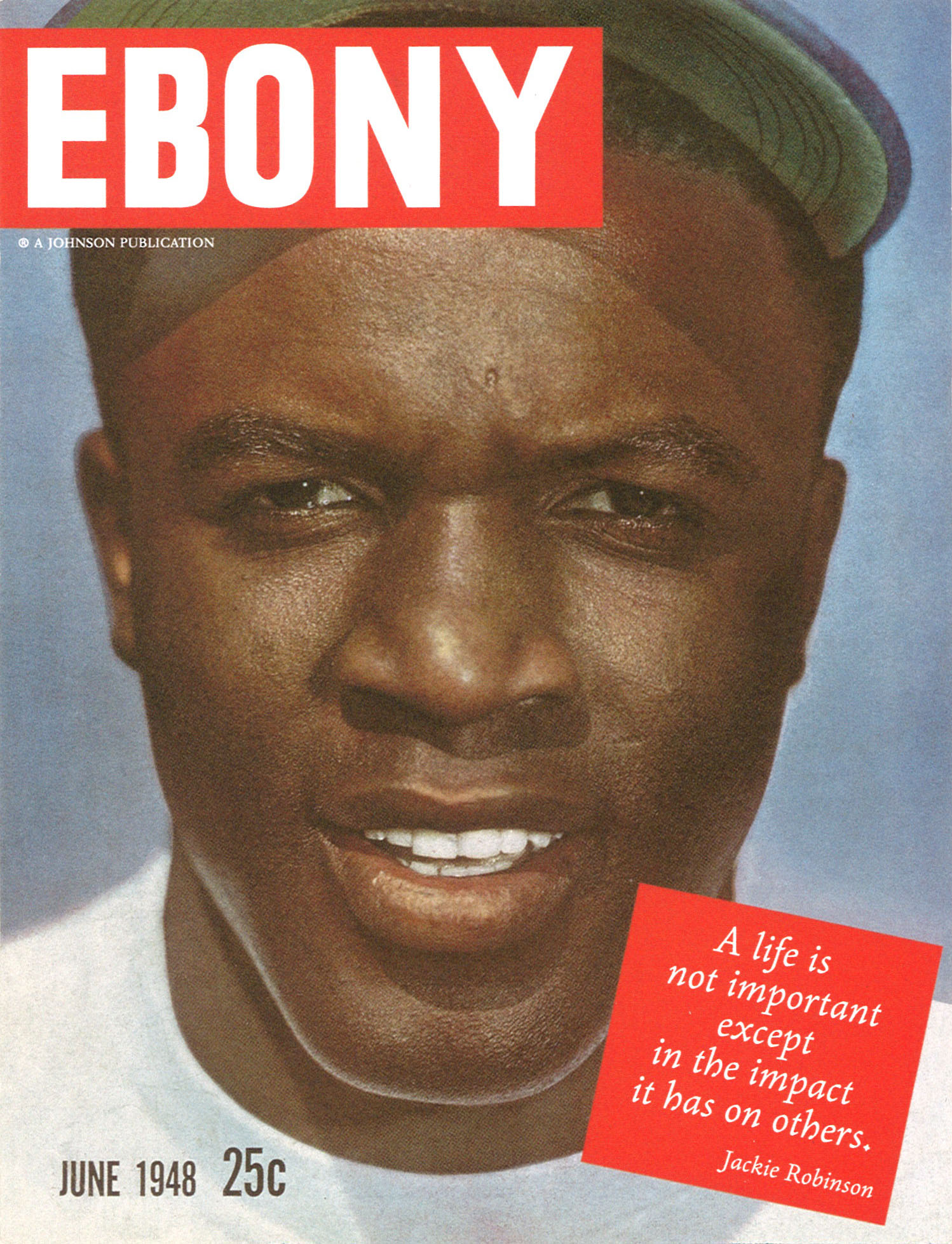
0664_001Six months ago in this space I lamented the end of the baseball season. Now, with the arrival of April and the return of Spring and the national pastime, it’s only fitting that we remember the Georgia native who made history in 1947 by being The First.

For most of us, being first is something we long for. Americans like being first in everything—first means gold medals, it means winning, it means recognition, it means an association with being the best, with something good. First in line; first-come, first-served. The first in our class. First edition. The first to climb Mount Everest. First in the polls. First in war, first in peace, first in the hearts of his countrymen. The first sign of spring. The first time ever I saw your face. The first kiss, the first dance, the first date, the first to walk on the moon. The first day of the year. The first. Number one.

But what if being first means having people hate your guts? What if going to work every day meant you were open to taunts, threats, and physical violence? And what about volunteering to be the first at something you know is going to be the hardest road you’ve ever walked down in your life? Why would you do it? Would you do it? Honestly, most of us would say, let this cup pass from me. We are reminded of William Shakespeare’s great lines: Some are born great; some achieve greatness; some have greatness thrust upon them.

After World War II, Brooklyn Dodgers president and general manager Branch Rickey was looking for a way to put more fannies in the seats at Dodger games and to make his team better. Every team president wanted to do that. But the other thing Rickey had in mind seemed downright radical and, some thought, un-American. He wanted to break baseball’s color barrier and put a black baseball player on the Brooklyn Dodgers. A dangerous piece of social engineering, to be sure. To give you some perspective, that same year, 1947, the Memphis Censorship Board banned the movie Curley because it showed black and white children playing together. If you thought opposition to health care reform was intense, what Rickey wanted to do seemed unimaginable. There had been an unofficial “gentlemen’s agreement” against such a thing since the nineteenth century. But Branch Rickey, a man born in the late nineteenth century in Ohio, thought it was a good idea.

Who would he sign? It would take a rare individual; it had to be someone with a relentless personality and a determined drive to succeed. Someone who could take the most vile abuse imaginable and turn the other cheek. Someone who could psychologically endure loneliness and extreme public persecution while simultaneously being a very good baseball player. History had summoned Jack Roosevelt Robinson.
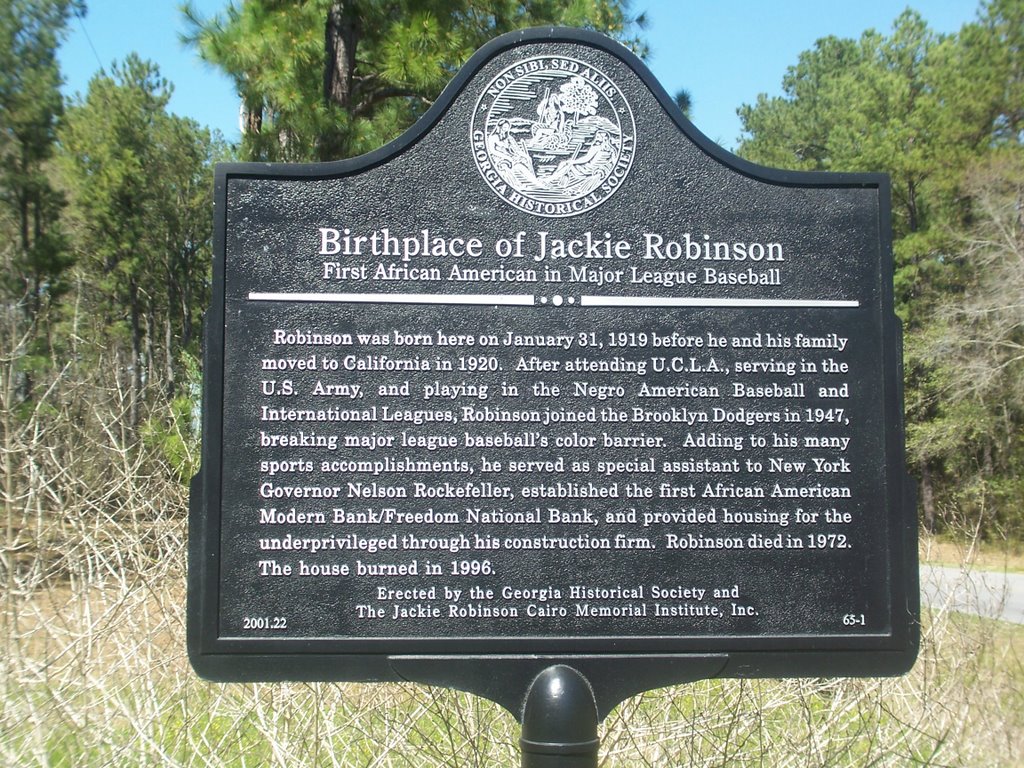
historical markerRobinson was born in Cairo, Georgia, on January 31, 1919. Abandoned by her husband, his mother Mallie moved the family to Pasadena, California, in 1920, and Robinson attended John Muir Technical High School and Pasadena Community College before transferring to the University of California, Los Angeles. At UCLA he was an outstanding athlete, lettering in four sports—baseball, football, basketball, and track—and he excelled in swimming and tennis as well. Jackie Robinson was used to competing at the highest level of competition, and he was no shrinking violet. Scott Simon called him “a hard-nosed, hard-assed, brass-balled, fire-breathing athlete.”

Robinson showed early that he was not afraid to stand up to bigotry. He was drafted in 1942 and served on military bases in Kansas and Texas. With help from boxer Joe Louis, he succeeded in opening an Officer Candidate School for black soldiers. Soon after, Robinson became a second lieutenant. Late one evening at Fort Hood, Texas, Robinson got on a bus and spotted a fellow officer’s light-skinned wife who could easily be mistaken for white; he sat down next to her. The bus driver stopped the bus and yelled out, “Hey boy! Get to the back of the bus!” Robinson refused and faced a court martial. When a private at MP headquarters later that evening asked Robinson if he was “the nigger lieutenant” who had gotten in trouble, Jackie told him, “If you ever call me a nigger again, I’ll break you in two.” In the end, the order was ruled a violation of Army regulations, and he was exonerated. Shortly after leaving the Army in 1944, Robinson joined the Kansas City Monarchs, a leading team in the Negro Leagues.
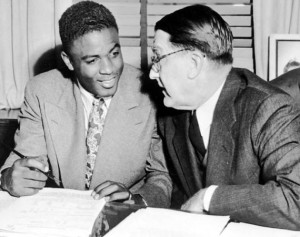
Robinson-RickeyWhen Branch Rickey signed Jackie Robinson and finally brought him up to the big leagues in the spring of 1947, baseball’s “Great Experiment,” as it was called, electrified America. Probably the only rookie given a day in his honor, Robinson trailed only Bing Crosby in a year-end national popularity poll. Virtually the entire black population of America became Dodger fans. At the end of the season, Robinson had been named the league’s Rookie of the Year (an award that now bears his name), gaining respect throughout the baseball world and beyond. Three years later he won the batting title, hitting .346, was named Most Valuable Player, and led the Dodgers to the World Series. Over a ten-year career he hit .311, and played in six all-star games and six World Series. He was voted into the Baseball Hall of Fame in 1962.

It sounds like he won American Idol, doesn’t it? But this is to sum up a year and a career, and we don’t live our lives like that. We live out each minute and each hour, sometimes in excruciating pain. For Jackie Robinson, 1947 was an entirely different experience, a hell on earth.

The kind of public torture that Jackie Robinson faced few of us, thank goodness, will ever know. We all remember the public humiliation we felt and the laughter we faced from our peers when our mothers made us wear raincoats to school or take an umbrella on days when it rained, or when she made you wear a tie to school on picture day. And while few things in life equal the scorn of tormenting 13-year-olds whose approval you would desperately like to have, for most of us that’s as bad as it will ever get. But the rites of passage we all knew in our adolescence are not what I’m talking about. I’m talking about the special level of hell reserved for those first black students who walked up the steps that morning at Little Rock Central High School in 1957. For the first former slave who walked to a polling place and told a white man that he was there to vote after the Civil War. For the first women who attended law schools. This is the kind of first that Jackie Robinson volunteered for.

In a now-legendary meeting, Dodgers GM Branch Rickey confronted Robinson with the wide range of abuse he knew Robinson would face. Robinson listened to Rickey talk, growing visibly angry, and finally blew up. “Do you want a player afraid to fight back?” he shouted. Rickey replied no, that he wanted someone even tougher than that, someone, he said, “with the guts not to fight back.” Restraint would be the measure of his courage. Rickey told him, “Jackie, we’ve got no army. There’s virtually nobody on our side. No owner, no umpires, very few newspapermen. And I’m afraid that many fans may be hostile. We’ll be in a tough position. We can win only if we can convince the world that I am doing this because you’re a great ballplayer, and a fine gentleman. You cannot fight back.” He told Robinson, “I need someone who can carry this load.” Robinson agreed that for three years, he wouldn’t fight back. He wouldn’t speak up. He wouldn’t argue. He would simply take it, and all the while he would try to perform at the highest level. Failure wasn’t an option.

Many thought Rickey would pick the great Satchel Paige, and when he wasn’t chosen reporters sought him out. Was he bitter or disappointed? No, Paige said with enormous class, “They didn’t make a mistake by signing Robinson,” he told them. “They couldn’t have picked a better man.” In Scott Simon’s words, Rickey had anointed a knight to ride out first.

But being first means being a target, and it began with members of his own team. In spring training, Dodgers manager Leo Durocher had to squelch plans for a players’ petition against Robinson in a midnight meeting. But when some Dodgers actively protested against Robinson, Durocher stood up to them: “Listen, I don’t care if this guy is white, black, green or has stripes like a f’ing zebra. If I say he plays, he plays. He can put an awful lot of f’ing money in our pockets. Take your petition and shove it up your ass. This guy can take us to the World Series, and so far we haven’t won spit.”

When the team went on the road in spring training, Robinson had to stay in different hotels, separate from the rest of the team, and eat in different dining rooms. And always he was alone. The famous Dodgertown complex later erected was in part a response to the problems that Robinson and other blacks faced with spring-training racism. His teammates kept their distance in the dugout and on the field. One sportswriter said that Jackie Robinson looked to him, sitting in the dugout all by himself, away from his teammates, like the loneliest man in the world. He knew that nearly everyone wanted to see him fall flat on his face, to make a fool of himself, and of Branch Rickey, who was accused of being a communist and a socialist. After the start of the season, the St. Louis Cardinals were rumored to be planning a strike in protest of Robinson. Vile insults and black cats were thrown at him from the stands in St. Louis. Some of the worst abuse came from players on opposing teams.

The Phillies were managed by Ben Chapman from Alabama, and he told his players that when Robinson came to bat, to open up with both barrels, to taunt and bait Robinson with all they had, “to see if he can take it.” Hitting a major league curveball is considered one of the most difficult of all athletic achievements. Imagine trying to do it while hearing things like this coming from the opposing dugout:

“Hey nigger! That ball ain’t no watermelon boy!”

“You can’t play with white boys, you know that! Get back to the jungle, nigger boy!”

“Hey nigger, why don’t you go back to the cotton field where you belong?”

“Hey, snowflake, which one of those white boys’ wives are you dating tonight?”

“We don’t want you here, nigger!”

We can wonder now how anyone could have been so ignorant. Or how he could have endured it. There were references to thick lips, thick skulls, and syphilis sores. The stands rained down with tomatoes, rocks, watermelon slices, Sambo dolls, and the most vile things you could ever say to another human.
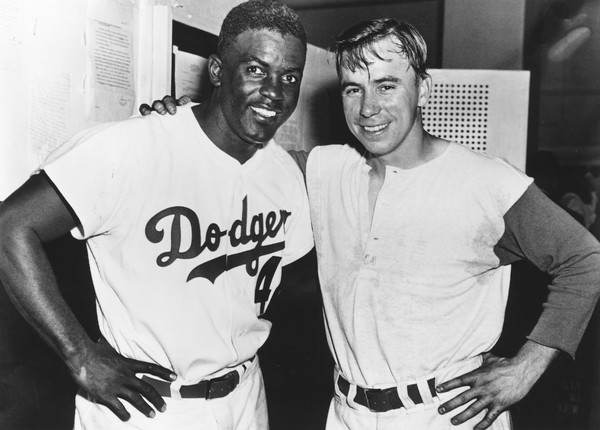
jackie robinson pee wee reeseIt did something even to his own teammates, who for the most part had left him alone, had kept their distance. Dodger Eddie Stanky—also from Alabama—had enough. He stood up on the dugout steps and called Chapman a coward and told him to pick on someone who could fight back. In Cincinnati, Dodger shortstop Pee Wee Reese,a native of Louisville, Kentucky, put his arm around Robinson’s shoulder to show his support for his teammate. A small thing, really, but a hugely symbolic moment that was lost on no one and meant the world to Robinson.

There were other moments, with other teams. In Pittsburgh, Robinson and the great Hank Greenberg, who was Jewish and had been called vile names himself, collided on a violent play at first and Robinson was called safe. It was a tense moment. They each got up, dusted themselves off, and as Robinson took his lead off first base, he heard Greenberg say behind him, “Stick in there. You’re doing fine. Keep your chin up.” After the game, Robinson told a reporter, “Class sticks out all over Mr. Greenberg.”

As Branch Rickey later remembered, racists like Chapman actually brought the Dodgers together as nothing else could. “He solidified and unified thirty men, not one of whom was willing to sit by and see someone kick a man who had his hands tied behind his back.” Incidentally, Jackie Robinson scored the only run that day. The Dodgers beat Chapman’s Phillies 1-0. God does have a sense of humor.

He said later that that day almost broke him. For one moment, he remembered, he thought, “to hell with this.” “I was, after all, a human being. What was I doing here turning the other cheek as though I weren’t a man?” Robinson said he wanted to “stride over to that Phillies dugout, grab one of those white sons of bitches, and smash his teeth with my despised black fist.”

That Jackie Robinson had to go through something like that just to play a game is shameful, but it gives us some insight into the character of the man that he endured it, bore it with grace and dignity, and thrived in spite of it. He stood there and took it, and he did it, he said later, for his mother who had kept his family together after being abandoned by his father, for his brothers who never got this kind of chance, for Branch Rickey who displayed enormous courage himself, and for all the ones who would come after him. It was for good reason that much later his daughter Sharon wrote a children’s book about him entitled Testing the Ice, which he did both literally and metaphorically. This was a man whose life provided a foundation upon which so many others would build. Willie Mays said later that every time he looked at his house he thanked God for Jackie Robinson.

After three years, Robinson pushed back. He argued with umpires, he protested second-class accommodations, and no one ever taunted him to his face. But having to internalize all of it killed him, quite literally. He was dead by 53. It is his name we remember today, and not those of the small men who taunted him.
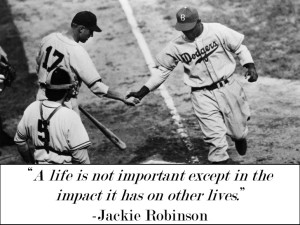
jackie quoteThis is what makes history so fascinating to me: you can read all day about how depraved humans as a species have been, but then you come across someone who inspires you by simple acts of courage and dignity. Jackie Robinson was not a great military hero or politician; he never took a city by force, never won an election, never conquered an army, never explored unknown lands, never founded a colony. He never started a war or ended one. Nor was he a saint. No man is. He was just a baseball player, albeit a great one; but he was so much more than that. As someone once said, it didn’t take a great baseball player to break down that barrier. It took a great man.

Even if she never likes baseball—and she will—I want my daughter to know about Jackie Robinson. I want her to learn that many things she might take for granted were achieved only with great sacrifice and at a very high cost, and that she will have opportunities in her life—to vote, to go to college, perhaps attend law school, become a doctor, a CEO, a writer, a soldier, a teacher, a baseball player—because someone else opened a door that was closed and carried the weight of being first upon their shoulders. And should she herself ever be called upon one day to step forward and be the first in some field or endeavor, she could have no better example of how to walk a difficult and lonely yet dignified path than the life of Jackie Robinson.
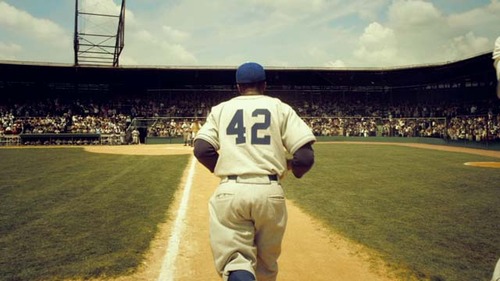
rounding thirdRobinson was a brave and courageous man, one of those rare souls who, when the great question is asked, “who will go first?” didn’t avert his eyes, put his head down, or walk away. He stepped forward and said, “I will.” When he took the field on April 15, 1947, and kept taking it, day after day, he didn’t just make the Dodgers better. He made the human race better. “I’m not concerned with your liking or disliking me,” he said, “all I ask is that you respect me as a human being.”

Play ball.

The Bases are Loaded and I Wish I Was Too: The High Flying Birds, Bye Bye College Football, Hello Deflategate, and the Ghost of Skip Caray

Loyal readers of this space know that I’m passionate about books and history. I also love sports and we’ve reached that point in the calendar where another season of college football has gone to earth, with their professional brethren soon to follow. Baseball doesn’t start for two months—the regular season at least—but pitchers and catchers will be reporting to spring training in about 3 weeks. In the meantime, the hockey and basketball seasons are in mid-stride and if you’re in Atlanta, something magical is unfolding right in front of our eyes with the Hawks. Let’s take stock of it all. First up:

logoThe Atlanta Hawks: There are 30 professional basketball teams in the NBA, and on any given night their arenas are full. The league was founded in 1946 and has grown in popularity every year since, particularly after the rise of stars like Wilt Chamberlain, Julius Erving, Magic Johnson, Larry Bird, Michael Jordan, and LeBron James. Over 21 million people attended an NBA game last season, with an average attendance of over 17,000 at each game. Professional basketball is an international sport, and NBA players are among the highest paid athletes in the world.

I say all of this because outside of those arenas, it’s hard to find anyone who actually identifies themselves as a pro basketball fan. I happen to be one and have been for about 40 years. I actually played league basketball in my middle school years, back when almost everyone was vertically challenged, not just me. I suppose that’s how I got interested in the Hawks.

The ’76-77 team was the first I really followed, coached by Hubie Brown and featuring John Drew, Truck Robinson, Steve Hawes, and Lou Hudson (“Sweet Lou,” his last with the Hawks after 11 seasons). The next couple of seasons they added Charlie Criss (my favorite player, at vintage-ad-dr-j-for-converse5’8″ the shortest player in the league before Spud Webb arrived in 1985), Tree Rollins, Eddie Johnson, Dan Roundfield, Jon Koncak, and of course the Human Highlight Reel, former Georgia Bulldog Dominique Wilkins. Good ‘ol Skip Caray called the games on Superstation TBS. As the clock ticked down to another victory, Skip always happily exclaimed “it’s cocktail hour!”

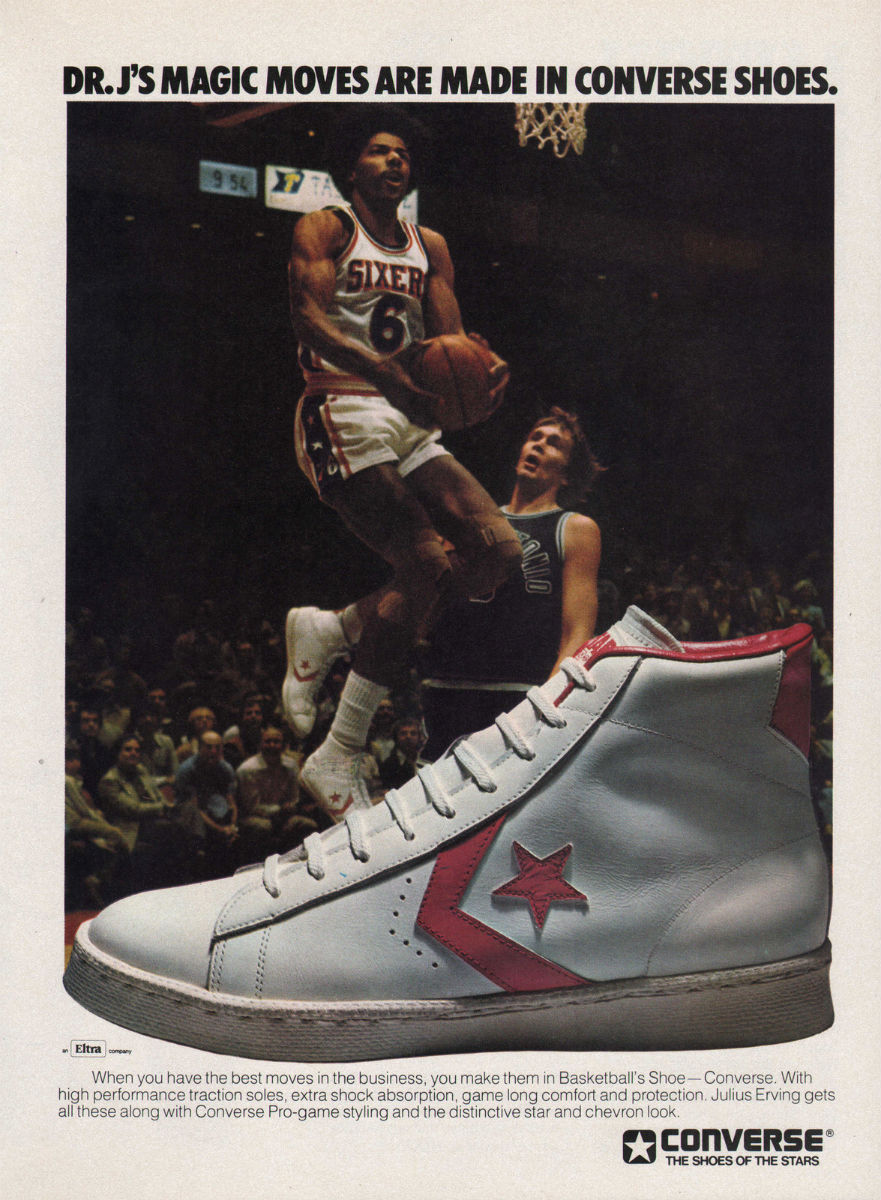
When my friend Scot Hawes and I were growing up we regularly watched Dr. J as he soared above the rim for one of his signature tomahawk dunks. We wore his Converse high tops (seen in a vintage ad here), and tried to shoot like former Hawk Pistol Pete Maravich in the numerous Horse games we played in my driveway.

Try finding an unabashed NBA fan now. They’re harder to find than the Golden Ticket in a Wonka Bar. But that’s changing rapidly this season in Atlanta, however, and with good reason.

As of this writing, the Hawks are 38-8. That’s 38 wins and 8 losses, through 46 games. Halfway through this season, they have already equaled last year’s win total. Yes, that sounds good, but wait—there’s more. They lead the Eastern Conference and have won a franchise record 17 games in a row and are 31-2 in their last 33 games (a .94 winning percentage). That’s good—really good. In case you’re wondering, they’re halfway to the NBA record for consecutive wins: 33 straight by the ’71-72 Lakers with Wilt the Stilt, considered the best team of all time.

How have they managed to do this? Unselfish team basketball and great defense. And how did that happen? Because suspended General Manager Danny Ferry hired Coach Mike Budenholzer two years ago. Coach Bud served as an assistant for 18 years under Coach Gregg Popovich of the San Antonio Spurs. The Spurs play unselfish team basketball, great defense, and—oh yeah—they win championships. Five of them, to be exact, since Pop took over in 1996.

If you watch the current Hawks, you can see the same style: great, unselfish play, passing the152060902_Wizards_Hawks_Cunningham0208 ball, finding the open man, great defense. This team is just flat-out fun to watch, a dream for all of us long-suffering Hawks fans who lived through the torment of Iso-Joe Johnson and big baby Josh Smith. There aren’t any stars on the current team, just great basketball players like Jeff Teague, Kyle Korver (pictured here after draining a 3), and Al Horford. (Of course, if you’ve followed Atlanta sports for any time at all, you’re just holding your breath till one or two of our key guys go down with a season-ending injury.)

The Hawks might or might not win a championship this year, but something special is going on that makes the end of football season much easier. They are as dialed-in as any team can be, and the wins just keep piling up. Cocktail hour indeed. Stay tuned here. The Hawks haven’t won a championship since 1958, and that was when they were in St. Louis, but there might be pro basketball in Atlanta in June this year. Which would mean we wouldn’t have to watch the Braves, which will be a huge relief. More on that in a moment.

College football: The inaugural college football playoff is history, and all concerned havemeyer deemed it a rousing success. For the first time, a select committee chose the four top teams and seeded them 1 through 4. They squared off against each other, first in two traditional New Year’s Day bowls, with the two winners of those games advancing to a championship game ten days later. The lowest-seeded team, Ohio State, won it all this year (Buckeyes Coach Urban Meyer is pictured here), which of course raised all sorts of questions.

Chief among them: was there really that much difference between the #4 team that got in and the #5 team—in this case Texas Christian—that was excluded from the playoff? No, there wasn’t. So immediately there’s talk about expanding the playoff to six teams, with the top two seeds getting a first-round bye. That would mean extending the season by at least one week and some college presidents have objected to more missed classes for more practices, etc. But make no mistake: with the huge ratings garnered by this year’s three playoff games, there are millions to be made by expanding the number of teams and it will undoubtedly happen. What won’t happen: those student-athletes won’t be getting any of that additional compensation. But that’s another issue.

Also troubling, at least to me, is that as much as I’ve clamored for a college football playoff through the years, once it was all said and done, I felt that the regular season had been cheapened somehow. In former years, #1 Alabama would have played #2 Florida State for the BCS national championship. Ohio State, this year’s eventual champion, would not have even been in the mix. The Buckeyes reached the playoff on the strength of having lost only one regular season game and a convincing 59-0 beatdown of Wisconsin in the Big Ten conference championship game. In former years they would have gone to a good BCS bowl and that would have been the end of it. Not this year. The #4 seed won the whole enchilada. But stay with me, this is not a rant against the Buckeyes.

Which leads me to say that if the playoffs are expanded to six or even eight teams, be prepared for that sixth or eighth seed to win the national championship. It might be a team with two losses in the regular season pulling an upset of an undefeated team in the playoffs. But it’s no longer about who the best team is at the end of the season, but rather who gets hot for about a month—just like in the NFL, the NBA, the NHL, major league baseball, and college basketball. In other words, just like in all those sports, it’s now about winning a tournament.

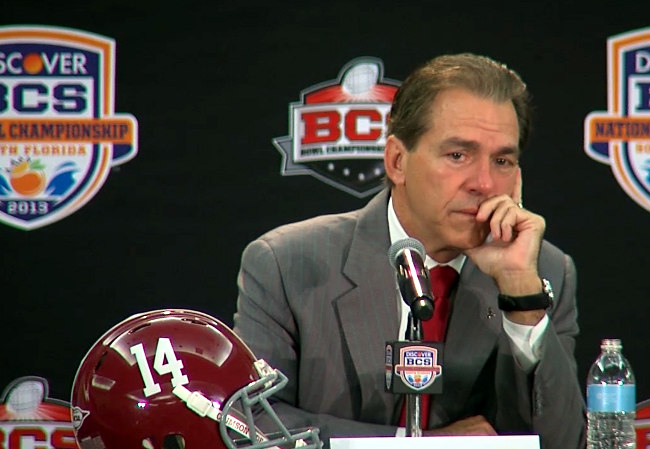
M20515449_BG1aybe that’s okay. I’m not taking anything away from the Buckeyes—they beat the SEC champs in the Sugar Bowl in what amounted to a home game for Alabama (here’s Bama Coach Nick Saban answering questions at a press conference in his usual gleeful manner) and then beat the Pac-10 champion Oregon Ducks, who put up 59 points against Florida State in the Rose Bowl. They won their way to the championship, and lost only one game in the regular season, their second game on September 6 against a Virginia Tech team that finished 7-6. That loss was clearly an aberration.

But there’s no doubt that something has changed in college football that has made crowning its champion more like the other round-robin free-for-alls that mark other major sports, and I’m not sure that’s a good thing.

Why does this bother me? For the same reason it bothered me the first time a wild-card team won the World Series in baseball—the 1997 Florida Marlins, who finished nine games behind the Braves that year in the regular season. How could they possibly be baseball champions when the finished in a distant second place during the regular season? But they were. It’s happened six times since that year, including this past season with the San Francisco Giants. The Red Sox broke their long championship drought in 2004 by winning the World Series as a second-place wild card team. How has this happened?

Baseball plays a 162-game regular season for 6 months, and then rewards two second-place teams in each league with playoff spots as wild-card teams. Those teams can get hot over the course of a month and win the whole thing. Are they in fact the best team, or just the winners of the playoffs? Is there a difference?

They clearly weren’t the best team over the course of a 6-month season. Given 162 games to prove it, a wild-card team couldn’t finish first in their division. But they can get into the playoffs and play their way to the championship over the course of one month. At the same time, a team that finished in first place during the regular season suddenly finds their bats have gone cold and their pitching not as precise when October comes.

This is also a function of playing a series, as happens in baseball, hockey, and pro basketball—best 3 out of 5 or best 4 out of 7 games—rather than a one-game winner-take-all approach that prevails in football and college basketball. Would Ohio State have beaten Alabama or Oregon 4 times in 7 games? It doesn’t matter, they didn’t have to. They only had to win once against each team, and they did. Same in the NFL. (The first wild-card team to win a Super Bowl, by the way, was the 1980 Oakland Raiders. Five other teams have done it since, most recently the 2010 Green Bay Packers.)

Where does this leave us? Still with a bit of chaos in college football, just as in the BCS era, and I suppose we should get used to it. It’s highly doubtful that any one conference will dominate the sport as champion as the SEC did for seven consecutive seasons between 2006 and 2012. Winning two playoff games—and perhaps three in the future—will be too high a hurdle for any one conference to do year after year after year. That’s probably not a bad thing either. But still, you can’t argue with the fact that as entertainment, this year’s college football campaign was pretty darn good. Stay tuned.

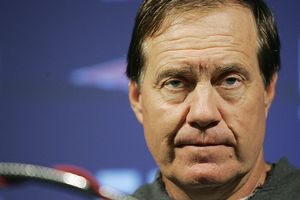
Pro Football: Ah, the NFL. Fresh off the Ray Rice controversy and with Superbelichick Bowl 49 looming, all the talk is about the Patriots (here’s Coach Bill Belichick joyfully facing the media) using under-inflated footballs in the AFC championship game against the Colts on
January 18. Unless we’re talking about the balls used in the kicking game, in a game decided by a field goal, who cares about underinflated pigskins, really? Yes, I know it speaks to the integrity of the game, and yes, I know we’re talking about the team that gave us Spygate here, but c’mon man.

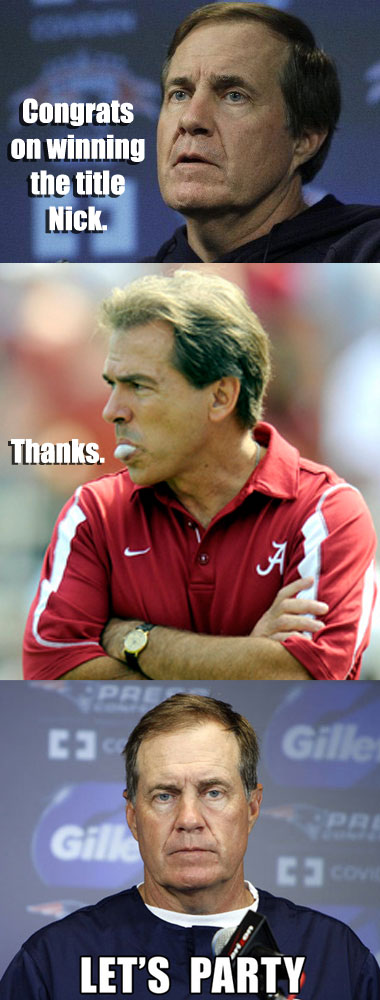
belichick-sabanThe only thing we know for certain after all the drama and press conferences surrounding this subject over the last 10 days is that Bill Belichick makes Nick Saban look like Doink the Clown in the charisma department. Belichick has all the charm and personality of a bowling shoe. At any rate, however all of this plays out, the NFL has another problem on its hands in a season filled with off-the-field fiascos, and the Patriots have to deal with a huge distraction in the run-up to their sixth Super Bowl in the Belichick era.

Meanwhile, Atlanta’s NFL franchise has fired its head coach—the winningest in team history—and appear to be poised to hire Dan Quinn, the defensive coordinator of the defending Super Bowl champion Seahawks after his season ends next Sunday. His defenses are the best in the league, and the Falcons finished last in that department last season. At least they didn’t make the mistake of hiring the human train wreck that is Rex Ryan. The Falcons need a coach with integrity and class, not a buffoon.

Speaking of Doink the Clown and buffoons, this finally leads us to…

The Braves: Sigh. Having traded away much of the talent that was on last year’s edition, the Braves are poised to revive the dreadful years of the late ’70s and ’80s, when the aforementioned Skip Caray regularly told his listeners, “Well Braves fans, the bases are loaded and I wish I was too.”

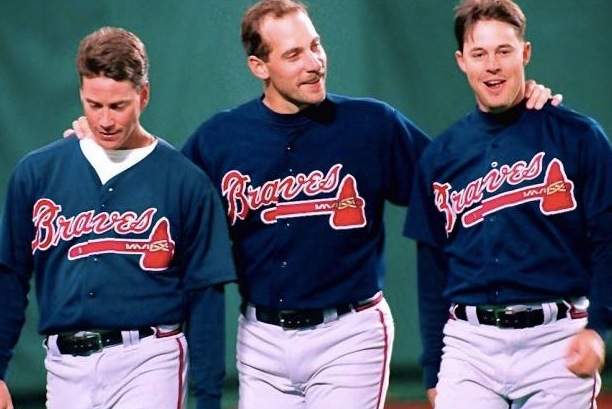
photoBraves management appears to be in full-blown fire-sale and re-building mode while trying to convince us that they’re not exactly dismantling the ’27 Yankees. Maybe not, but they are tearing down for the most part the squad that won 96 games just two seasons ago. Those of you who lived through those dreadful years mentioned above may want to dust off those “Not Too Shabby” placards and get yourself fitted for that paper bag you’ll be Knicks-Fans-Wearing-Bags-Over-Their-Heads-In-New-Orleans1wearing over your head all summer (like the Knick fans at left). All of this is ironically happening at just the moment that Atlanta’s Big Three from our golden years—Tom Glavine, John Smoltz, and Greg Maddux, pictured above—are inducted into the Hall of Fame. It’s going to be painful to watch.

In the meantime, grab the remote and watch Kyle Korver rain down those threes. It’s poetry in motion. And college football returns in 7 months.

Mr. Smith Goes to War: The Curious Case of the Fighting 50 Year Old

Movie Review: Fury (2014) Starring Brad Pitt, Shia LaBeouf, Logan Lerman, Michael Pena, and Jon Bernthal. Written and directed by David Ayer.

“War is cruelty and you cannot refine it.”—William Tecumseh Sherman

furyThe World War II movie has been around as long as the war itself. Hollywood began churning out anti-Nazi flicks even before combat began in Europe in 1939, and from the moment Japanese bombs fell on Pearl Harbor Tinseltown was all in. Some of its best efforts, like Casablanca, weren’t even about war, but about how the conflict disrupted lives and displaced lovers.
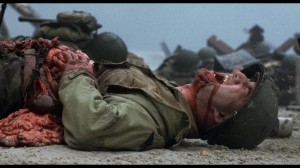
We could review some of the films that came out during the war (and some of them were quite good), but one movie released 53 years after the war’s end changed everything. Steven Spielberg’s Saving Private Ryan in 1998 took combat on film to a level and anscreenshot-med-02 intensity never seen before, and no movie made after it can hope to pretend to anything other than farce if it doesn’t measure up.
To be sure, other films before that—particularly Oliver Stone’s Platoon (1986), Spielberg’s Schindler’s List (1993) and Michael Mann’s 1992 version of Last of the Mohicans—brought a sense of realism to the violence and trauma of war that hadn’t been present before. But the opening twenty minutes of Private Ryan, which recreated the D-Day landings of June 6, 1944, were harrowing and graphic in a way that left audiences riveted and many veterans traumatized. I saw it six times in the theater and many times since on DVD and its impact remains unchanged.

Now comes David Ayer’s Fury, released October 17. The story of a American tank crew in the last days of the War, the movie stars Brad Pitt and a nice ensemble cast, and it follows the genre in all its clichés perfectly.

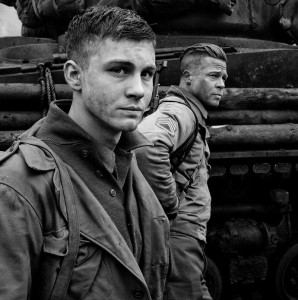
Brad Pitt;Shia LaBeouf;Jon BernthalThe World War II buddy movie has a time-worn formula that movie makers are loathe to give up. You’ve seen it many times. The squad is made up of a motley and diverse cast of characters who all make jokes at each other’s expense but who of course love each other and are bonded by combat. There is always a wisecracking New Yorker with a Brooklyn accent; a Midwesterner, usually nicknamed “Iowa” or “Nebraska”; a Southerner, often a sharpshooter (think Sergeant York), who dryly quotes scripture almost every time he’s on screen and putting a bullet in somebody’s head. He is invariably nicknamed something like “Hillbilly” or “Tex”; a hard-boiled, brooding leader with a mysterious background who ends up usually hailing from either Pennsylvania or the Midwest and turns out to be either a mailman or a baseball coach before the war; and finally, one member who passes for a minority, either a Jew or a Hispanic.

Very early in the film one standing member of the group will get killed and will inevitably be replaced by a green-as-a-Granny-Smith-apple fury-008rookie who a) has never seen combat), b) is usually anti-violence and loathe to kill, no matter the circumstances and c) becomes the squad egghead and/or resident sissy who quotes poetry or will be seen reading a book of some kind during a lull in combat. This fellow’s manhood will be questioned, will be found wanting, will be put to the ultimate test, and he will, in the end, be the only one standing.
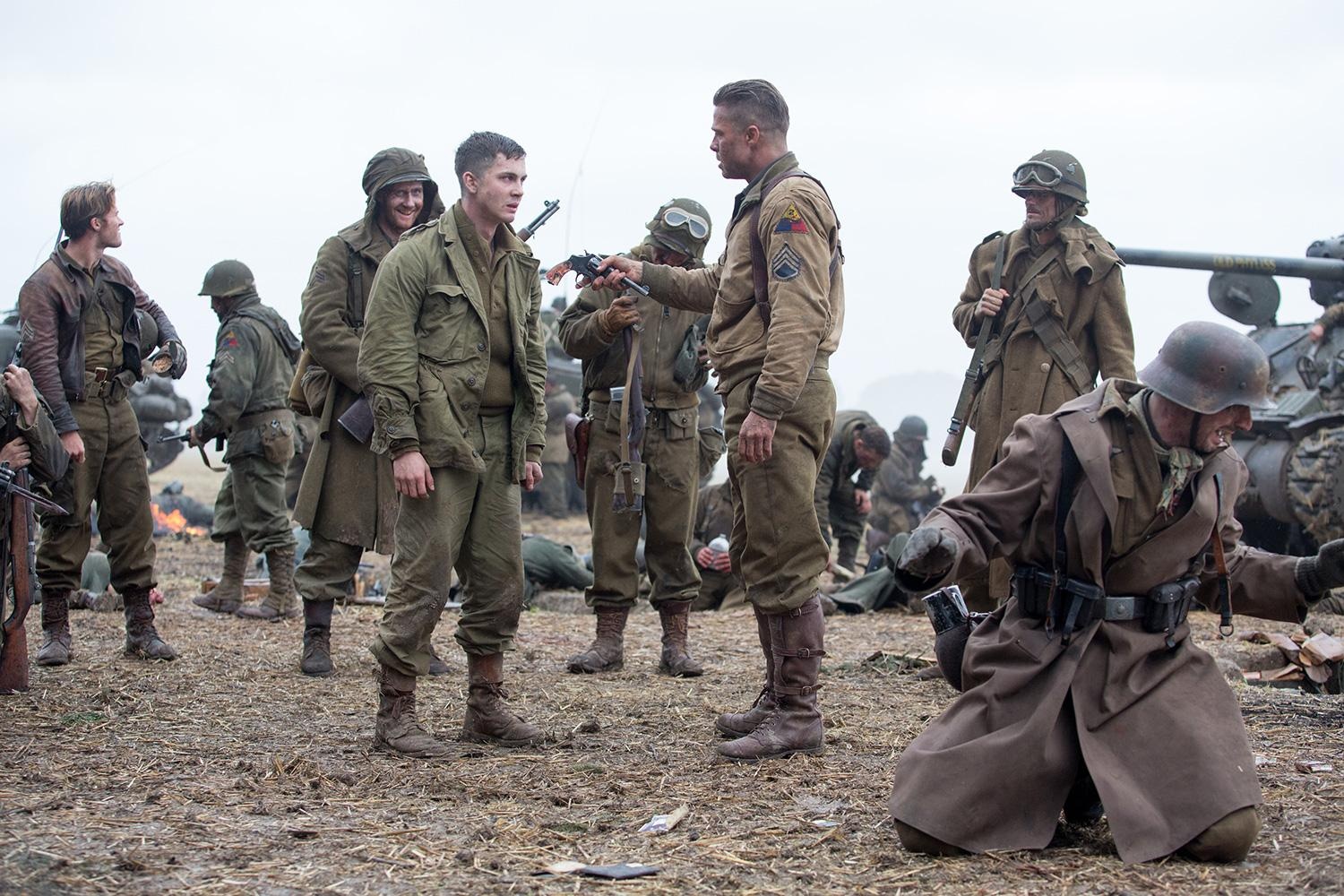
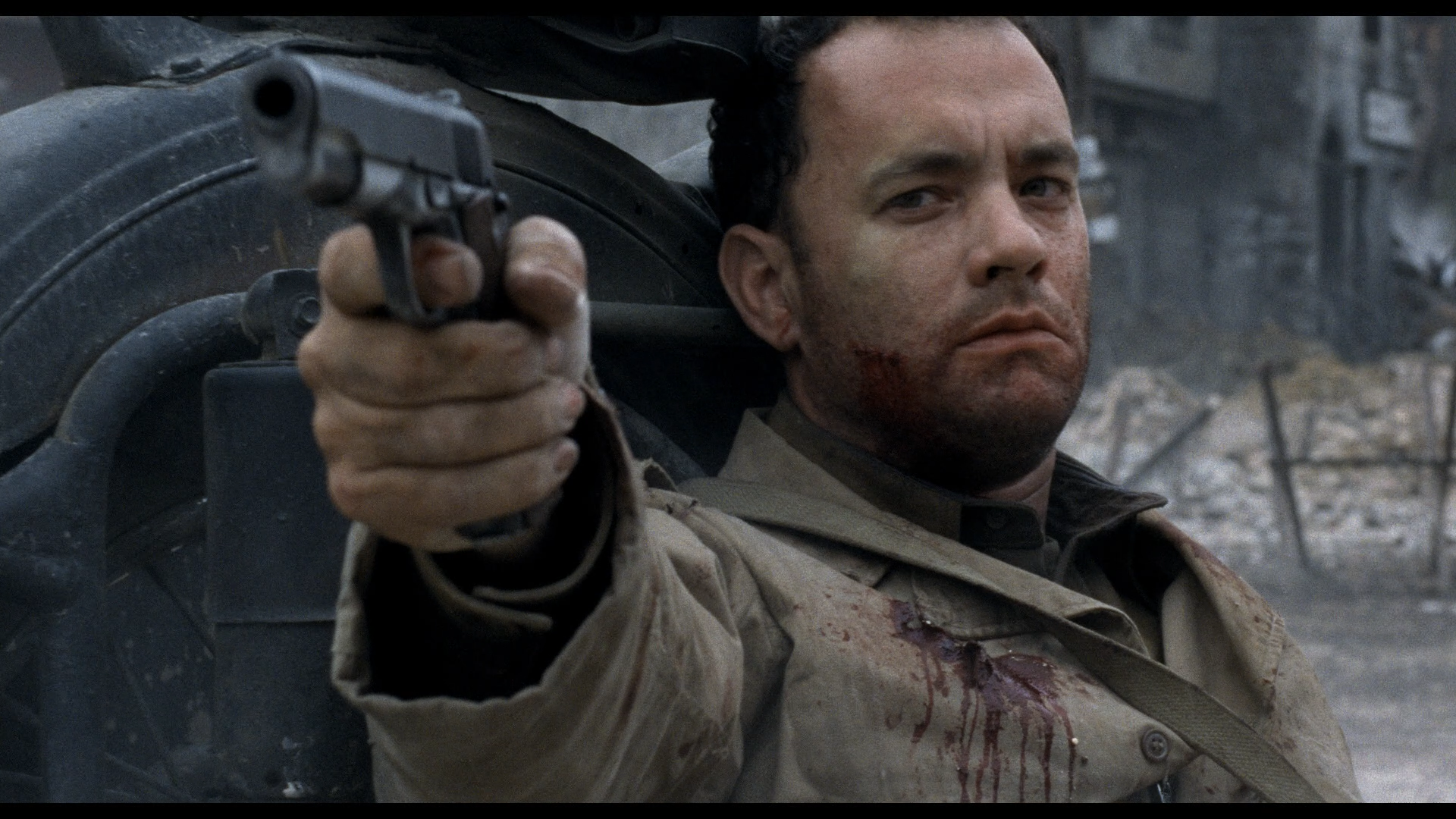
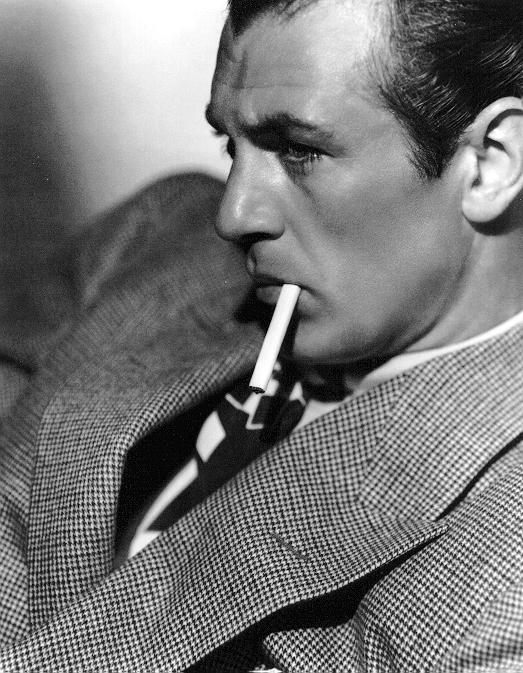
Also part of the formula: the squad will fight for most of the picture as part of a larger unit but near the end of the flick they’ll find themselves cut off from everyone else and forced to make a hard choice: run and try to re-join the larger group or stand and fight and face near-total annihilation while serving the larger cause. Guess which one they choose?

Saving Private Ryan, for all its combat realism, followed this formula right down to the last fury-movie-screenshot-016-1500x1000moment, and Fury does too. Unlike Spielberg’s film, however, Ayer’s offering is no love letter to the generation that fought the Big One. This is all about Sherman’s quote that began this blog—war is hell, and you cannot refine it. The movie opens with violence and follows it through right to the end, and you’re not always sure what the larger story arc is, other than survival. And that’s precisely the point. By April 1945, when this movie takes place, most combat veterans just wanted to make it to the end; whatever larger, overarching theme there is in this movie is juxtaposed with the soldier’s will and desperation to survive—another minute, another hour, another day, to make it to war’s end, and then back home again.

Saving Private RyanThere are of course things wrong with this movie, starting with the fact that there were no 50-year-old tank commanders in World War II. None. Nada. Zilch. If you were 50 years old and in the U.S. Army, you were a general. You were nothing else. Even Tom Hanks was beyond the age, at 42, of a captain in Private Ryan. Grizzled and weary WWII combat soldiers were 28.

To Brad Pitt’s credit—and this soon-to-be-50-year-old is eternally grateful—he makes you forget he’s 50. He’s as plausible in this role as he’s ever been in anything he’s done in his long career, and in this instance his pretty-boy looks and youthfulness serve him well. Those same attributes often make you overlook the fact that he’s a fine actor, but this time he makes the most of them without making that the reason you cheer for him.

CooperTo my mind, this role is a turning point in Pitt’s career. He is as close now to what passes in Hollywood for a Gary Cooper or a Clark Gable—the man who, when he is on the screen, commands your attention without even opening his mouth. Pitt does that numerous times in this movie, sometimes quite literally taking command of a situation that threatens to explode right in front of you, and he never even moves. If George Clooney is our modern-day Cary Grant, and Tom Hanks is Jimmy Stewart, Pitt is Coop, The King, Errol Flynn, and in some ways Henry Fonda all rolled into one—a character with an earnest but quiet dignity that evokes the best moments of those stars from Hollywood’s golden era.

One thing this movie does well is muddy the waters of the narrative of the American G.I. Whatever else Stephen Ambrose would have us believe about the American soldier as liberator, there are moments in this film when one wonders how excited the German civilians were to see the Americans roll into town. War obliterates all rules, and even the most civilized people can be brutalized and desensitized by unrelenting violence. Fury demonstrates this well. Ayer’s G.I.s are not the sort of people you’d meet at an ice-cream social, and Americans or no, there’s no mistaking the reality that Western Civilization itself was a casualty of this war.

Another point that is well made in this film: American military personnel did not take any German S.S. as prisoners. Members of the S.S. were trained killers, and they were treated as such, a point made repeatedly in all the recent movies and mini-series. Watch for it here too.

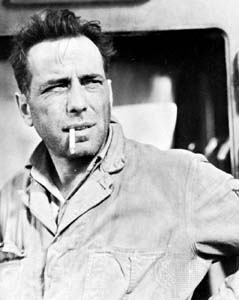
Is this the best WWII tibogart001p1ank movie ever made? Nope. Since this is a blog about history, my money is still on Humphrey Bogart’s 1943 classic, Sahara, which employed all the buddy war-movie clichés but with a United Nations cast, and with Bogart’s ultra-cool, towering performance that still stands over 70 years later. Every generation needs to interpret World War II for itself and let its stars stand in for those of yester-year, whether it was Bogart, George C. Scott as Patton, Clint Eastwood in the Vietnam-era Kelly’s Heroes, Tom Hanks, and now Brad Pitt.
In the end, what we’re left with is the sense that the war was big, messy, and traumatizing for all those who fought in it. Those who survived were damaged too, in different ways. It’s hard to come away from this film—or any other good one about war—and not be convinced that however necessary it might sometimes be, it always destroys more than it preserves.

This movie too, like its predecessors, reminds us—and we always need reminding—that, as Bruce Catton so eloquently put it, when the Great Challenge comes, the most ordinary among us will rise up and do great things. But the cost will always be high. As the World War II generation literally disappears from our sight, we’re haunted by the question of what all those young men left lying on WWII battlefields—and indeed from all wars—might have achieved if they had been allowed to return to a world without war.

The Way the Game is Played

1231690-derek_jeterFormer baseball commissioner and Yale president Bart Giamatti captured it best: Baseball, he wrote, breaks your heart: “It is designed to break your heart. The game begins in the spring, when everything else begins again, and it blossoms in the summer, filling the afternoons and evenings, and then as soon as the chill rains come, it stops and leaves you to face the fall all alone. You count on it, rely on it to buffer the passage of time, to keep the memory of sunshine and high skies alive, and then just when the days are all twilight, when you need it most, it stops.”

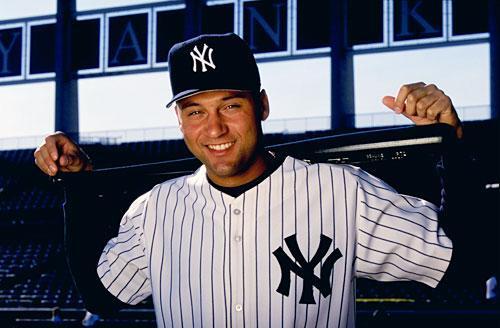
As a lifelong baseball fan, I’ve always hated to see the season end. Unless the Braves makes the playoffs, that is, which they didn’t this year, after another awful September. I love playoff season too, but this year is different. The end of the season marked the end of Derek Jeter’s career.

derek_jeter_1--300x300Before you Braves and Red Sox fans fill up my inbox with flaming burritos in protest, let me explain. I’ve never been much of a Yankee fan. Indeed, it’s still hard for me to accept the outcome of the 1996 World Series. The Braves, defending World Series champions that year, again won the National League pennant in ’96 and went to New York to open the series with the Yankees.

They promptly shocked the baseball world by winning the first two games in Yankee Stadium by a combined score of 16-1 behind the offensive firepower of Andruw Jones and Fred “Crimedog” McGriff and the dazzling pitching duo of John Smoltz and Greg Maddux. The next three games would be in Atlanta, followed by two more in New York if necessary. The Braves needed to win only two of those potential five games to clinch their second consecutive series. It was going to be Atlanta Braves baseball nirvana.

Except it never happened, of course. They lost the next four games and that was that, with the Yankees winning their first championship since 1978. Derek Jeter was on that ’96 team, playing in his first full season as a Yankee. The Braves lost to Jeter’s Yankees again in 1999.

So though I’ve never been a dyed-in-the-wool Yankee hater, I’ve not been partial to them either, as we say. But I can certainly respect the history of the great franchise and the great players who’ve worn the pinstripes—Ruth, Gehrig, DiMaggio, Mantle, Jackson, Mattingly, Rivera.

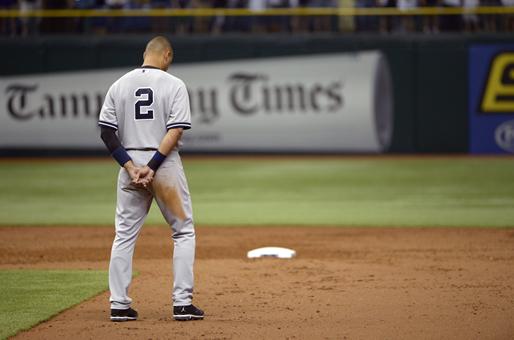
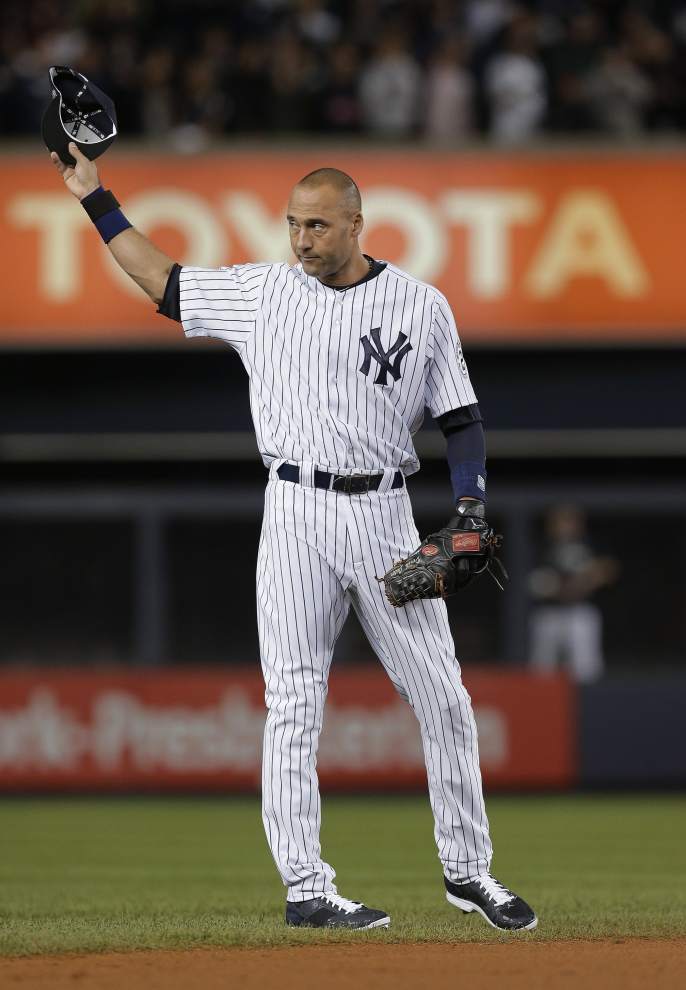
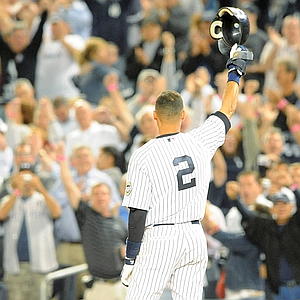
None, however, were ever better than number 2, who retired Sunday after 20 years in the big leagues. It was all in the way he played the game.

jeter1Baseball is a game of numbers, but it wasn’t just Jeter’s statistics that made him great, though they’re impressive enough too. One of the reasons I love baseball is that it’s so tied to its own history, as no other sport really is—every player who puts on the uniform is compared to all of those who have gone before. When Jeter legged out a single on Sunday for his last hit, it was number 3,465 in his career. Only five players in major-league history, across more than 145 years, have ever hit more. Only five. He finished with a .310 batting average, won five World Series titles, five Gold Gloves, five Silver Slugger awards, and was an All-Star fourteen times. He will be voted unanimously into the Hall of Fame.

In this, his last season, he played in 145 games. Only one other Hall of Famer in the last century, Al Kaline, played in more games in his final season. His walk-off game-winning single in his last game at Yankee Stadium on September 25 was the stuff of legend. And he played all twenty seasons with the same team, again a rare thing.

derek jeterBut the most impressive statistic about Derek Jeter to me? Zero. Across twenty major-league seasons, he was never ejected from a game. Not once. With my temper I would have rivaled Bobby Cox’s record for getting tossed out of games (158) if I’d ever been so blessed to play that long, so I can appreciate Jeter’s self-control perhaps more than anything. To play at that high level and never lose your cool enough to get thrown out of a game is remarkable indeed. It speaks to his character, his temperament under pressure, and yes, his upbringing too.

True to the best about the sport, baseball history was in play on his final day in uniform, last Sunday, September 28, in Boston. With two hits on Sunday, Jeter could have tied Ty Cobb’s record for the most seasons with at least 150 hits, with 18.The Georgia Peach played his last season in 1928, 86 years ago, so this is a cumulative record that speaks to skill and longevity, one not likely to fall very easily. Yankee manager Joe Girardi told Jeter about the record on Sunday morning, and asked if he wanted to play longer than his planned two at bats. Jeter said no. He would stick with just two trips to the plate and take the results, whatever they were.

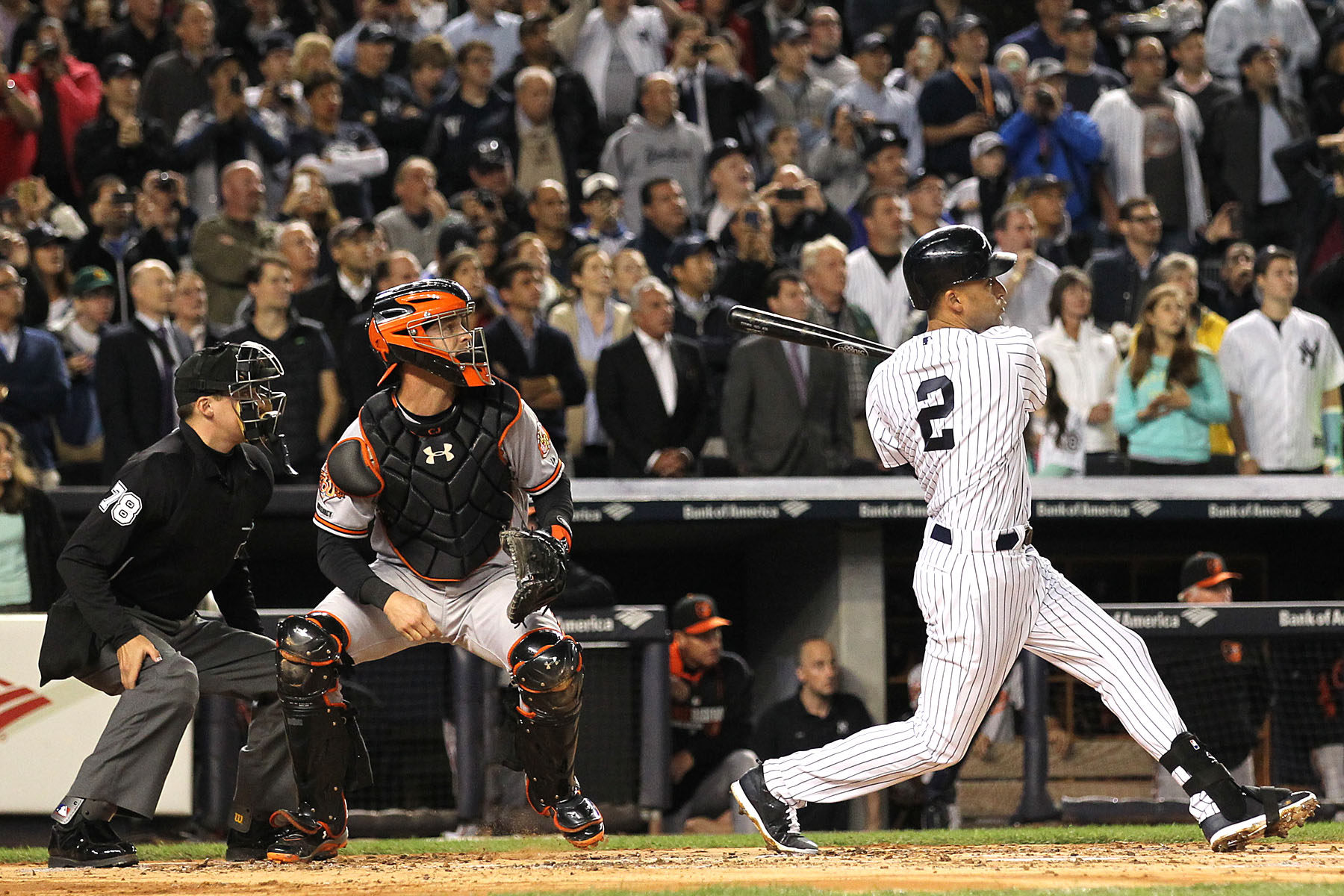
New York Yankees vs Baltimore Orioles“I never played the game for numbers,” he said. “So why start now?” He fell one hit short.

Others have more eloquently described Jeter’s career than I can, but as a lifelong fan of the national pastime, I know something rare when I see it. I’ve been lucky enough in my life to see some great baseball players in person. Long-suffering readers of this blog will recall that I saw Hank Aaron hit homerun number 713 in 1973. I saw the Big Red Machine in a championship year, and many other legendary players too numerous to mention across 40 years of attending big-league games.

Jeter played the game the way it’s supposed to be played, the way we all dreamed of back when we were playing ball with our friends out in the street or in the backyard, when we played just for the sheer love of the game. Jeter played that way every day.

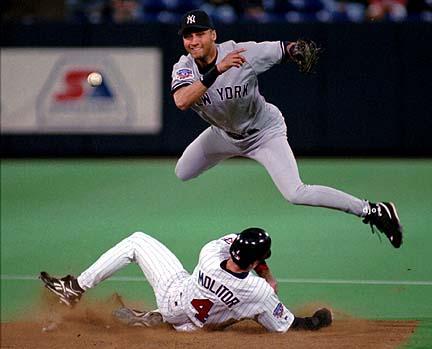
He played with an intensity that Pete Rose had, but without Rose’s arrogance. He played with unbelievable skill—no one will ever forget his famous flip in the 2001 playoffs against the A’s—with finesse, style, and above all, with class, both on and off the field. He didn’t run his mouth or think he was entitled, or create more headlines for what he did off the field than on. He respected the game and played it with honor.

Wa5MWHw3How remarkable was he? As I mentioned above, he played his last game in Boston, home of the Red Sox, the Yankees’ most hated rival, and the fans stood and cheered for him as if he were their own, long and loudly and with tears in their eyes. Red Sox greats from years past lined up to shake his hand. Boston’s a great baseball town, and they know a legend when they see one, but even this was something to see. It would be like UGA fans giving a retiring Steve Spurrier a standing and rousing ovation, if Spurrier had ever had one ounce of class.

Will we see his like again? Yes. One thing we know about baseball is that it renews itself, and as one era ends, another begins, even if it takes a few years to realize it. When Jeter came on the scene in the 1995 season, another Yankee legend—Don Mattingly—was ending his storied career. Donnie Baseball, now the Dodgers’ manager, played all 14 of his big-league seasons with the Yankees and retired with a career .307 average, one year before the Yankees began their championship run. It was the end of an era, but without our even knowing it at the time, a new one began that same season. It’s the way the game is played.

To watch a great athlete across his entire career is one of the great joys in life. To then see him walk away in the fading twilight is a reminder of our own fleeting youth, when we played the game with passion and love, and of our own mortality. It is a painful reminder, if we needed one, that all good things must end someday.

dt.common.streams.StreamServer.clsSo there is no joy in Mudville at the end of this season and the end of Derek Jeter’s splendid career. To paraphrase John Fogerty, this particular brown-eyed handsome man has rounded third for the last time. Like all great players who have gone before, Jeter will now gracefully stand aside and make way for others whose names we may not know very well—yet—but who will, in time, achieve greatness. They’ll be here as sure as one season follows another, keeping the memory of high skies, sunshine, and childhood alive. In another September we’ll lament they’re passing from the stage as well. It’ll break our hearts because baseball always does. It’s the way the game is played.

The Reason Why

vip-1982Teaching is not a lost art, but the regard for it is a lost tradition–Jacques Barzun

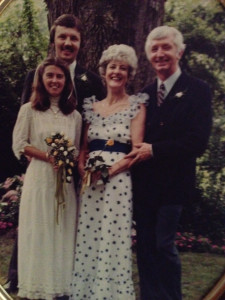
William Arthur Ward wrote that the mediocre teacher tells, the good teacher explains, the superior teacher demonstrates, the great teacher inspires. Carl Vipperman, my very first history professor at the University of Georgia, died on June 28, 2014, at the age of 86. I was honored and humbled to be the only one of the thousands of students he had in a 30-year teaching career to speak at his memorial service in Athens on July 2. I was privileged that day also to spend time with many of Carl’s friends and family, including his beloved wife Reggie, son Carl Jr.—known as Vip—and Vip’s wife Vick031801 Hometown #1ie (all pictured below, left, at Vip’s 1982 wedding).  I visited his beautiful Tudor-style historic home on W. Cloverhurst Avenue (at right), perused the book-lined shelves in his study, sat in his reading chair in the writing nook that he built in the backyard (reminiscent of writer Christopher Morley’s famous similar retreat, the Knothole), and walked the well-manicured grounds of Reggie’s beautiful gardens. Vip and I spent time in his father’s writing retreat that evening reminiscing over a glass of wine about his father and his own successful career as songwriter and musician. It was an emotional day of tribute to the good and gentle man who inspired me to choose the path of historian. Carl Jackson Vipperman was a great teacher, in the finest tradition of that honorablvip-fame but too often undervalued profession. You will see why I was asked to speak in the remarks that follow, which I delivered at his memorial service:

“I begin with a quote from Charles Dickens, which is
fitting not only because of what it says, but also because Carl Vipperman could quote literature like few other people: ‘That was a memorable day to me, for it made great changes in me. But it is the same with any life. Imagine one selected day struck out of it, and think how different its course would have been. Pause you who read this, and think for a moment of the long chain of iron or gold, of thorns or flowers, that would never have bound you, but for the formation of the first link on one memorable day.’

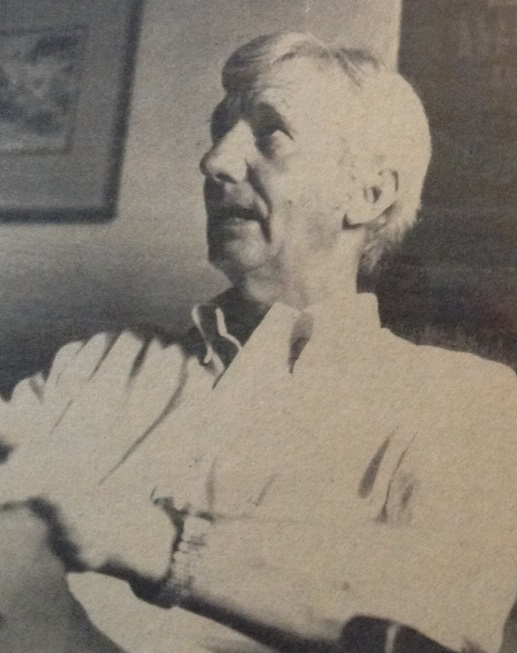
One of those days for me was Friday, September 17, 1982, my first day of college and the day I first met Carl Vipperman. I was taking History 251, the first half of American history, in the PJ auditorium and was one of 300 people waiting for class to begin. In walked Carl Vipperman. He was silver haired (though only a little older than I am right now), wearing a white button-down oxford shirt, blue jeans, and comfortable brown shoes. Unassuming. He didn’t look like a professor so much as the guy you meet hanging out down at the vip-studyhardware store. There wasn’t much to go on, but I remember thinking that I might actually be able to do this college thing, and that I liked Carl Vipperman. I didn’t know it at the time, but that day was for me one like Dickens described, a memorable day that made great changes in me and bound me with chains of gold and flowers.


For the next 10 weeks, Monday through Friday, Carl walked up on stage and talked about American history. He started with the Norse invasion and it seemingly took him weeks and weeks to get to anything resembling American history, but I loved it. He not only was a master lecturer, but his knowledge and depth of learning were constantly on display. He casually dropped in names of historical sites we should see, books we should read; he somehow managed to work in lyrics from songs and he recited poetry as well. I wrote it all down in my notes and it often sent me scrambling in those pre-Google days to the library to track down the source of the poetry, the rest of the song, or the book he had mentioned. And he did it all without a single note. Here was a man who loved what he did, was good at it, and who put his passion and enthusiasm on display five days a week without fail for all of us to see. I had never seen anything like it, certainly not among my high school teachers, bless them. Quite simply, he set a model for how a professor should conduct his class that left me disappointed many times over in most of my other non-history classes that I took during the next 4 years. (It certainly wouldn’t have happened the next quarter with the professor who taught HIS 252, the second half of American history. He was deadly boring and shall remain nameless.) Carl Vipperman lit a fire in me that never burned out.

vip-bass

Carl almost pursued a musical career and maintained that love all his life. He played the upright bass in an Athens trio called “The Professors” for years.

I loved history but didn’t major in it, getting my undergraduate degree in journalism instead. But I immediately went back for a master’s degree in history and was privileged to be in the history department in LeConte Hall at a very special time. I took more classes with Carl and got to know his remarkable colleagues: Nash Boney, Phinizy Spalding, Jim Anderson, Emory Thomas, Jean Friedman, Ron Rader, Charlie Wynes, Joe Berrigan, Kirk Willis, Bill McFeely, Bob Pratt, Will Holmes, Bud Bartley, Lester Stephens, Alf Heggoy, John Inscoe, Tom Dyer, Aubrey Land. These were scholars who treated us with respect and expected us to do the same with each other. They welcomed us into their homes for social gatherings with a warmth of spirit and generosity, of collegiality, that set a very powerful example. I learned later it was a rare thing indeed in the academy. I have never forgotten it or them.

My path led me into public history, where I’ve had a wonderful and very fulfilling career that has allowed me to do things I never would have imagined when I began this journey on that long ago September Friday.  In January 2006  I decided the time was way overdue for the man most responsible for launching me on that journey to know what he had done for me. So I wrote the following letter to Carl Vipperman:

‘Dear Dr. Vipperman: Please allow me to re-introduce myself to you. In my very first quarter at the University of Georgia, in the Fall of 1982, I took your American History class and it set me on the course of my life’s work as a historian and writer. For all these years, I’ve wanted you to know the enormous and positive influence you had on my life, but I’ve never taken the time to write you. Having gotten a doctorate and done a bit of teaching myself on the college level, I have had students approach me and tell me how much they enjoyed my class and appreciated how exciting I made my subject, how I had pushed them and challenged them to expand their minds. I would respond, ‘I studied under one of the masters.’ It always made me think about my own teachers–like you–and how much that was true of the best of them, but yet I’d never taken the opportunity to tell them so, to tell them how much they’ve shaped who I’ve become, the important role they played in my journey, and how much they mean to me–in short, to say a heartfelt and profound ‘thank you.’

vip-carving

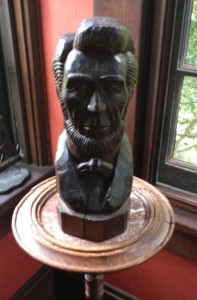
Carl was an accomplished woodworker, carving this bust of Abraham Lincoln.

First and foremost, you made history fun and exciting. Your teaching style was engaging and lively, your lectures were informative and humorous, yet packed with insight and analysis. And you did it all without any notes whatsoever! You could pick up on Monday morning exactly where you had left off on Friday, and never miss a beat. When the lecture was over, you always had time for students and their questions, and you never tired of conversations after class. Your warmth and generosity continue to inspire me, and the lessons you taught me in that classroom–as a scholar and as a gentleman–have stayed with me throughout my life. It was a privilege to be in your class.

As I watched you all those years ago, I asked myself, “How can I get a job doing what he’s doing?” I came to your office once and talked to you about a career in history, and though you discouraged me from getting an advanced degree in history due to the depressed job market, I didn’t listen! I went on to take your upper division course on Jefferson to the Civil War and though I received my undergraduate degree in journalism, I took my master’s degree in history there at UGA (working with Bill McFeely) and went on to get my Ph.D. in history at the University of Florida, where I studied under Bertram Wyatt-Brown. I would have never written my dissertation on South Carolina without your influence in that first class. It was you who first sparked my interest in South Carolina history, and it was your lectures that led me to take my first trip to Charleston. The vineyard of South Carolina history and historiography is a rich one, and your works on Rawlins and William Lowndes are both models of careful and thorough scholarship, good writing, and penetrating analysis. Indeed, anyone who labors in the field of history knows that their study would not be possible without the hard work and scholarship of those who have walked the vineyards before us and all who study the history of South Carolina stand in your debt.

vip-hatsThey say that a teacher’s influence never ends, that their influence is passed down from generation to generation. You are living proof of that. Rest assured, my dear sir, you have touched many other lives besides mine.  To quote Thomas Jefferson, writing to his friend John Adams in 1812, ‘No circumstances have lessened the interest I feel in these particulars respecting yourself; none have suspended for one moment my sincere esteem for you, and I now salute you with unchanged affection and respect. ‘ With all good wishes…’

Some time went by and I heard nothing. I thought, well, maybe my letter got thrown out with the junk mail. Who writes letters anymore anyway? Maybe I should have called or gone to visit instead. And then one day, nearly two months later, I found this email waiting for me one morning, with the subject line ‘Landmark Letter of January 31’:

Carl and his beloved Reggie

Carl and his beloved Reggie

‘Dear Dr. Deaton: I have delayed far longer than I intended in answering your letter and for that I must apologize.  Part of the reason was the profound impact it made at our house. As I didn’t have my glasses, my wife Reggie opened the mail and started reading your letter to me.  She was in tears before she got halfway through it, and when she finished, I said, ‘If I should fall over dead tomorrow, I want that letter read at my funeral, and I’d like for Stan Deaton to read it.’ If that comment sounds flippant, I assure you I could hardly be more serious.  Your letter established a landmark in my professional life. Over the years I have received many compliments, mostly verbal and some written, and the year after I retired in 1994, the history department established the Graduate Teaching Assistant Award in my name, which I appreciate very much.  But your letter is the first of its kind, coming from a student who did not major in history under my guidance, who wrote neither his thesis nor dissertation under my direction, who decided to become a historian against my market-prompted advice, who sought out the most challenging (and most rewarding) road to advanced degrees by choosing to study under McFeely and Wyatt-Brown, two of the best in the business

The writing nook built by Carl in his backyard that he enjoyed after his retirement.

The writing nook built by Carl in his backyard that he enjoyed after his retirement.

and among the most demanding in the profession, and who went on to establish himself as a respected member of my profession and especially among the community of historians in Georgia.  What I found most gratifying and at the same time most humbling in your letter was that you considered the American history survey course you had with me to be a pivotal point in turning your attention toward history as a profession.  That tends to vindicate what I have always believed, that introductory history courses are so important (1) for the enlightenment of ordinary American citizens on the historical character of their country and (2) for the recruitment of students like you for the history profession, that  indifferent or uninterested instructors should never be allowed near them. Stan, in closing I must say that your letter was a great gift to the household of this old retired historian.  You were lost to my memory before it came, but never again.  Reggie and I thank you again for your priceless gift, and wish you every success and future happiness.’

Someone should read Carl’s letter at my funeral.

One month ago I spoke in Savannah at the memorial service for a dear friend of mine who committed suicide. One of his cousins said to me, ‘there are going to be some rough days ahead. Let’s all be there for each other.”  I say the same to you today, in the spirit of my friend and mentor, who meant so much to me. Take the time to tell people what they mean to you, the influence they’ve played in your life. Before we are historians, scholars, teachers, we are human beings. Be kind to each other, lift each other up. Forgive other people, and be the first to reach out. Be there for each other.  The academy—indeed, life in any profession—can be a petty, mean-svip-hatpirited, ugly business, with nasty backbiting and turf wars that can hurt feelings and leave friendships and reputations destroyed. Carl Vipperman was living proof that one can rise above all of that, and live one’s life with honor and integrity while treating others with kindness and respect. He told us in class one day that our lives would last longer than our careers, to fill it with things like community, culture, conversation and friends. Service to others. Absorption in things other than self is the secret to a happy life, well-rounded and well-lived, like Carl Vipperman’s. I regret that I didn’t go to greater lengths to see him and spend time with him in these latter years, but I’m grateful that at the end of the day he knew how much he meant to me and the influence he had on my life.

Peace to Carl and all who knew and loved him, and honor and glory to his memory.”