In this episode, Stan looks at what happened to Hitler and his top henchmen—Goebbels, Himmler, Goring, Bormann, and others. How do we know so much about the Nazis despite the lack of physical remains, monuments and statues?

In this episode, Stan looks at what happened to Hitler and his top henchmen—Goebbels, Himmler, Goring, Bormann, and others. How do we know so much about the Nazis despite the lack of physical remains, monuments and statues?
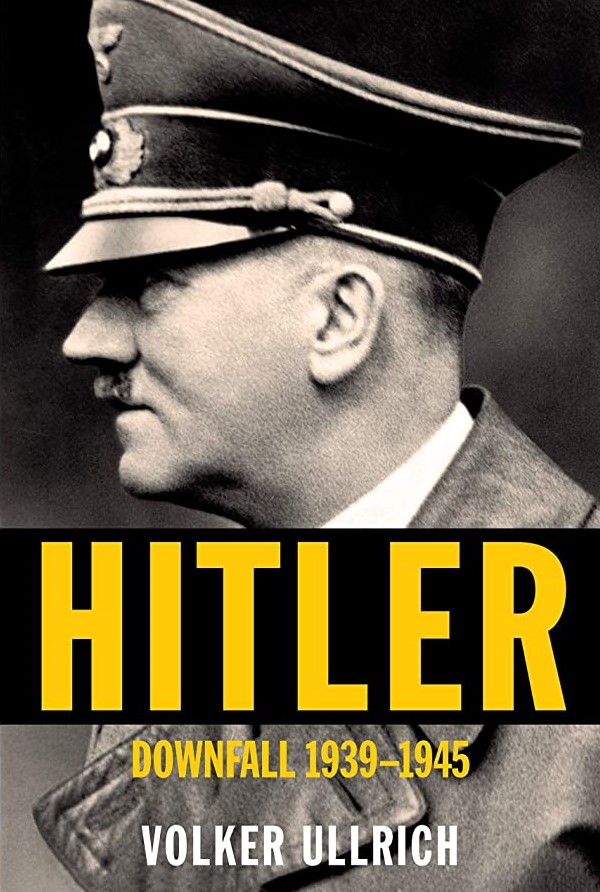 Volker Ullrich, Hitler: Downfall, 1939-1945 (Alfred A. Knopf, 2020, 838 pp.).
The first podcast that I ever recorded in this space, back in August 2017, reviewed the first volume of this fascinating biography of the Nazi Führer, Ascent: 1889-1939. Volume 2 followed here in the States in 2020, and I’ve just completed it. These 2 volumes are a worthy successor to the monumental biographies of Hitler by Ian Kershaw (2 volumes, 1998 & 2000), John Toland (2 volumes, 1976), Joachim Fest (1973), and Alan Bullock (1962).
Ullrich, the author, is German, born there in 1943 during the war, and it’s this nativity that gives his unsparing criticism of Hitler and his followers a moral weight it might otherwise lack. There is no trimming, no faint praise of the Nazis for making the trains run on time, no points for restoring German national morale after the devastation of the Great War—there is nothing here but unflinching critical analysis of the most heinous crimes ever carried out under the authority of government, all while focusing like a laser on the man from whose brain it all sprung.
This blog is not a full-on review of this book, simply a whole-hearted endorsement of it for anyone who wants to understand how the most evil regime in history came to power, held onto it for 12 years while demonizing Jews and other minorities, waged brutal and genocidal war, and then was utterly destroyed by the combined Allied might of the world’s leading democratic and communist regimes.
It is of course a story of unimaginable horror, but Ullrich’s real gift is helping us to see Hitler and his fellow Nazis as people, not as monsters.
This is important because, as he points out in the first volume, if they were in fact monsters then everything they did would be explainable. The fact is, they were flesh-and-blood human beings, which demands of good historians that they explain how the Nazis came to power with all their sociopathic and full-throated hatred for Jews, Eastern Europeans, and communists in full view. There were no secrets about what they intended to do. They then led one of the most cultured societies in Europe—not against its will, according to Ullrich—down the path of total war and ethnic annihilation, at the cost of hundreds of millions of lives.
To do all this is no easy task, but Ullrich pulls it off. Even as we already know the outcome, it is still a riveting story. Across 600+ pages of text we witness the invasion of Poland and the beginning of World War II, the air war with Britain, the fall of Paris, the titanic struggle with the Soviet Union, the enslavement and butchery of millions on the Eastern front, the Allied landing and the liberation of Europe, and the ongoing and horrific Final Solution. Through it all, Ullrich “normalizes” Hitler and in the process makes him seem more inhuman than ever, Still, as he writes, “there will always be aspects of Hitler we cannot explain.”
No matter how many books, documentaries, and films are produced about them, the story of Adolf Hitler and the National Socialists will remain a repelling and fascinating part of our history of which we can’t get enough. It is a subject that is both timely and bottomless. As Ullrich wrote in Volume 1, there will never be a “definitive” biography of Hitler because “people will never stop pondering this mysterious, calamitous figure. Every generation must come to terms with Hitler.”
As another German historian, Eberhard Jäckel wrote, “We Germans were liberated from Hitler, but we’ll never shake him off. Hitler will always be with us, with those who survived, those who came afterwards and even those yet to be born. He is present—not as a living figure, but as an eternal cautionary monument to what human beings are capable of.”
Adolf Hitler and the Nazis came to power 90 years ago this week, on January 30, 1933. The world is still coming to grips with the horrors of the Third Reich, even as anti-Semitism and authoritarianism are both again on the rise.
It is a stark warning to all of us that, though Hitler and his regime may be gone, their legacy and influence are not. Right now, there are those seeking power by demonizing other people and feeding the worst instincts to hate and fear other human beings. Hitler reminds us, as Ullrich concludes, “how thin the mantle separating civilization and barbarism actually is.”
We stand by and say nothing at our peril.
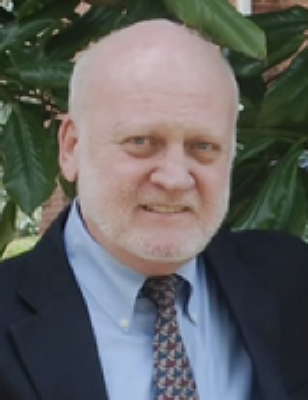 We received word here at GHS this week of the death of our dear friend Ed Jackson on Tuesday, January 10, 2023, age 79.
The Kingsport, Tennessee, native grew up in Texas, but it was the people of Georgia and their history that he made his life’s work.
Ed went to the University of Mississippi in the early 1960s and received his B.A. in History and an M.A. in political science. He put both of those to good use when, in 1970, he arrived in Athens at the University of Georgia and began a long and distinguished career at the Carl Vinson Institute of Government, retiring as Senior Public Service Associate 40 years later, in 2010.
During those 40 years Ed became the acknowledged expert, the man to ask about Georgia history and government. He trained governors, legislators, state employees, mayors, civic organizations, teachers, students, authored textbooks, spoke extensively, published widely, compiled databases, created over fifteen websites, photographed every corner of our state, and collected anything and everything that he could get his hands on about Georgia history, from postcards, to photographs, maps, artifacts of all kinds, campaign signs, and everything beyond and between that could tell the story of Georgia and her people.
Here’s what I said about Ed in the GHS’s Headlines newsletter yesterday: “Ed Jackson’s knowledge of Georgia’s people and history was unparalleled. He was Georgia’s unofficial state historian, and all of us beat a path to his door to dip into that deep reservoir of learning. There was no subject related to Georgia that he didn’t know something about, and that he would gladly and freely share. Every conversation with him left you wiser. He was also a great friend to this institution, through his membership, his time and resources, and the knowledge that he shared through his writing and research. The Georgia Historical Society is honored to be the repository of the Edwin Jackson Collection, ensuring that his documentary legacy will live on and that his vast collection of Georgia materials will continue to inspire and teach future generations. Though not born here, Ed Jackson was one of Georgia’s great treasures, and the people of this state that he served so long and so well are richer for all he taught us.”
When the Georgia flag-change controversy was at its height in the early part of this century, Ed was the go-to expert. He lectured on the history of our state’s flags for GHS in Athens and Savannah and published an article about it in the Georgia Historical Quarterly. And who else do you know that was awarded the “Vexillonnaire Award” by the North American Vexillological Association? Ed was, in 2004, for his work with the Georgia General Assembly’s efforts to redesign Georgia’s state flag. (Vexillogy is the study of flags, and no, I didn’t know that either.)
Ed had an extensive stamp collection (he was a founding member of the Georgia Federation of Stamp Clubs, now called the Southeast Federation of Stamp Clubs), and he once lectured here in our Research Center during the Georgia History Festival on Georgia history as told through stamps.
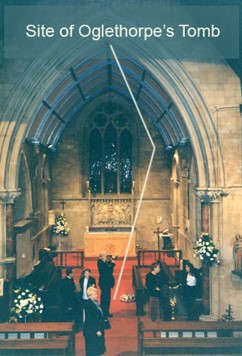 When the online New Georgia Encyclopedia needed an authority to write the entry for Georgia’s founder himself, James Edward Oglethorpe, they chose Ed. That forbidding subject would have daunted most historians, but not him. (That’s Ed in the center of the picture to the right, taking a photograph at Oglethorpe’s tomb in England.) For good measure, he also wrote seven other entries for the NGE, including for Georgia’s Historic Capitals, the Dixie Highway, Georgia’s State Flags, the current Georgia State Capitol, and the Legislative Process. He also served as a section editor for the NGE.
Every time I called Ed and needed help, he was always happy to assist, whether it was asking him to write an article for GHS’s Georgia History Today popular history magazine (where he wrote about the Dixie Highway, FDR in Georgia, and any number of his other passions), querying him about a fact on a proposed historical marker, or to answer one of my many arcane questions about Georgia history. He was never too busy, he never said no, and he never took a dime for all he did for GHS. If he could help further the mission of Georgia history, he would.
It’s no exaggeration to say that we would not have been able to do “Today in Georgia History” in conjunction with Georgia Public Broadcasting without Ed Jackson. It was his website, “GeorgiaInfo,” created for the Vinson Institute, that provided a roadmap for all the subjects we’d cover day to day over the course of the year. Naturally, he made it all available to us—and to everyone else—without any desire for personal credit. He only wanted to teach Georgia history, and if his website helped GHS and GPB do that, then he was glad to help.
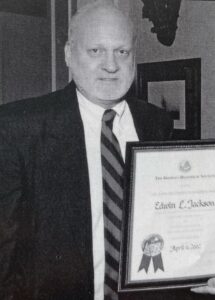 GHS honored Ed in 2002 with the John MacPherson Berrien Award for Lifetime Achievement in Georgia history (pictured here), and in 2012 with the Sarah Nichols Pinckney Volunteer Award.
Ed donated his vast and extraordinary collection of materials related to Georgia history to the GHS just a couple of years ago. The Edwin Jackson Collection at the Georgia Historical Society is now being processed, and when completed and opened for research it will be a treasure trove of riches that will be mined for decades to come.
Thank you, Ed, for all your years of self-less service to others, in the finest tradition of Non Sibi, Sed Aliis, Not for Self, But for Others, harkening back to the original Georgia Trustees. Thank you for your years of friendship to the Georgia Historical Society, to the University of Georgia, to the State of Georgia and her people—including all those yet unborn. They too are in your debt. Thanks to you, the path forward will be brighter for all those who look to the past to help light the way.
Georgia never had a better friend than this adopted son, and he will be deeply missed. He is quite irreplaceable.
We salute you, and farewell.
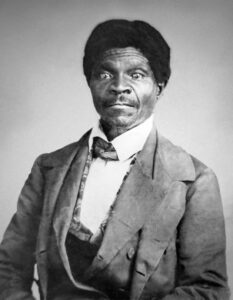 The Supreme Court’s decision was highly anticipated—and was leaked before the Court’s announcement. The Court would be ruling on the most contentious issue of the age, one that had threatened to tear the country apart for decades. When it was announced, one side hailed it as the final word on a divisive subject, finally laying the issue to rest. The other side exploded in moral outrage, charging the court with action far beyond its jurisdiction by trying to solve a complex and difficult political issue, overturning a long-standing precedent, and vowed to disregard the ruling and take the appeal directly to the American people.
Sound familiar? It was March 6, 1857, and the case was Dred Scott v. Sanford. It has often been called by historians “the worst Supreme Court decision ever handed down.”
Dred Scott was an enslaved man who lived in Missouri (a slave state) with an Army surgeon, Dr. John Emerson. Emerson took Scott to the free state of Illinois and then on to the free territory of Wisconsin, where Scott married his wife, Harriet Robinson. Four years later they returned to Missouri with Emerson. After Emerson’s death, his widow refused to sell the Scotts their freedom. With the help of anti-slavery lawyers, Scott sued, claiming that his residence in Illinois and Wisconsin meant that he was free. The case worked its way through state courts. Mrs. Emerson eventually transferred Scott’s ownership to her brother, John Sanford, who lived in New York state, moving the suit into Federal jurisdiction. The case finally made its way to the Supreme Court, presided over by Chief Justice Roger Taney of Maryland.
Missouri applied for statehood in 1820 as a slave state, which would have upset the Congressional balance of power between free and slave states. Maine came in as a free state at the same time, but Congress, passing the Compromise, ruled that all future territories west of Missouri and north of Missouri’s southern border at latitude 36°30′ would be free. The Missouri Compromise had held for 37 years, even as the agitation over slavery in the western territories had fiercely divided the country.
The Taney Court, in a 7-2 decision, handed down its decision on March 6, just two days after pro-slavery Pennsylvania Democrat James Buchanan’s inauguration as the 15th president.
Taney could have ruled that Scott, being Black and enslaved, was not due his freedom and left it at that. But Taney went much further, ruling that Black Americans—whether enslaved or free—were not citizens, had never been citizens, and would never be, ignoring the precedent that African Americans were citizens in several states already. Not being citizens, he ruled, they had no standing to sue in any court in the United States and in fact had “no rights which any white man is bound to respect.”
Again, Taney and his majority could have stopped there. But Taney wanted to put an end to the acrimonious debates threatening to rend the Union asunder. He ruled that the Missouri Compromise of 1820 forbidding slavery in the western territories had been unconstitutional, that Congress never had the right to forbid or abolish slavery in any territory. Slavery followed the flag.
Associate Justice James Moore Wayne of Georgia played a large role in pushing the Court to go farther than simply issuing a narrow ruling. Hoping that the Court could do what politicians seemingly could not—settle the slavery question for good—Wayne was instrumental in persuading the Court to rule the Missouri Compromise unconstitutional, and his concurring opinion went farther in supporting Taney’s than any other justice’s.
The White South embraced the decision as an answered prayer while a storm of anger swept across the North. Georgia’s Robert Toombs bragged that he would call the roll of his slaves under Boston’s Bunker Hill Monument, while abolitionists exploded in outrage when they read newspaper headlines that boasted, “The Triumph of Slavery Complete.” Northern Free-Soilers and champions of popular sovereignty—the right of citizens in each territory to decide the issue for themselves—thought the ruling a blow against democracy. Ultimately the decision split the Democratic Party into irreconcilable factions while uniting the nascent Republican Party in opposition to what it considered an outrageous case of judicial overreach that had no moral validity and insulted freedom-loving Americans everywhere.
The decision proved to be a disaster for the Supreme Court and the proslavery advocates who celebrated it. The Court’s reputation was damaged, and far from quelling the slavery issue, the decision backfired, pushing the country ever closer to Civil War. That conflict did exactly what Taney had denied possible: It destroyed slavery and, through the Reconstruction amendments, made citizens of the formerly enslaved, in the process forever altering the relationship between the Federal government and the American people.
The Black struggle for full citizenship during the era of Emancipation and Reconstruction would lead to the great Civil Rights revolutions of the 20th century—and, ironically, the heavily politicized Dred Scott case helped pave the way.
Stan explores the origins of Veterans Day 100 years in the aftermath of World War I, and how Savannah has honored and memorialized those who served and died for their country.