Author Archives: Stan Deaton

One Night Only, 40 Years Later

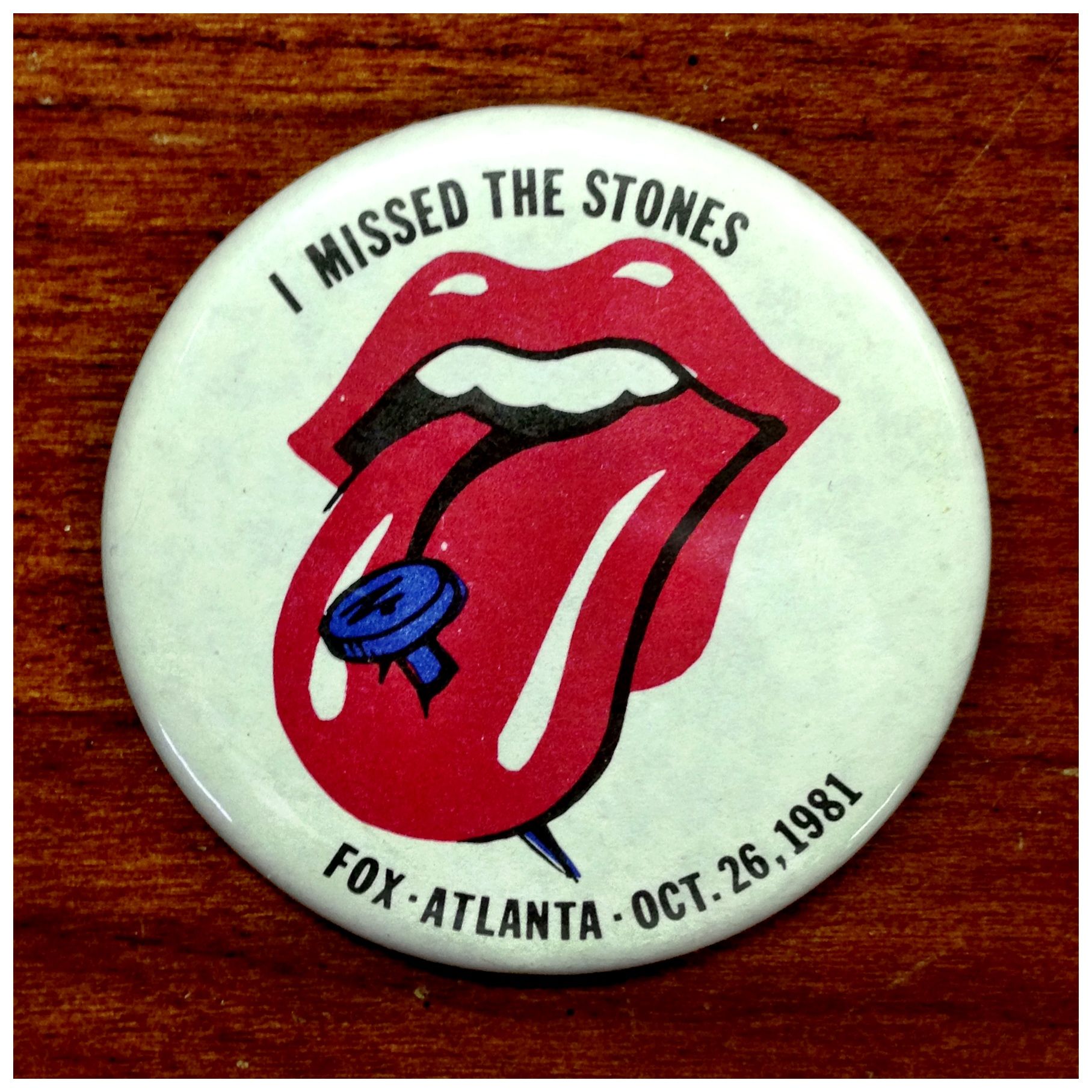
Forty years ago, on October 26, 1981, the Rolling Stones brought their North American tour to the Fox Theater in Atlanta. Tickets went on sale—less than 5,000 of them—about two weeks earlier, at 2:30 in the morning, only at the Fox box office. Most were snatched up by sleepy Georgia Tech students. When Atlantans woke up the next day, they heard that the Stones were coming, the show was already sold out, and you had a better chance of seeing Bigfoot than scoring tickets to the show. While almost all the other shows on the tour were in stadiums or large arenas, the Stones chose the intimate Fox for the Atlanta show.

Thanks to my brother Jeff—who stayed up all weekend before winning tickets by being the 93rd caller to an Atlanta radio station on that Monday morning—I turned out to be one of the relatively few people who saw that legendary show. As long-suffering readers of this blog know, it was one of the foundational nights of my life. My first Stones concert, and coincidentally also the first for Stones keyboardist Chuck Leavell, who has become a key component of their ongoing success.

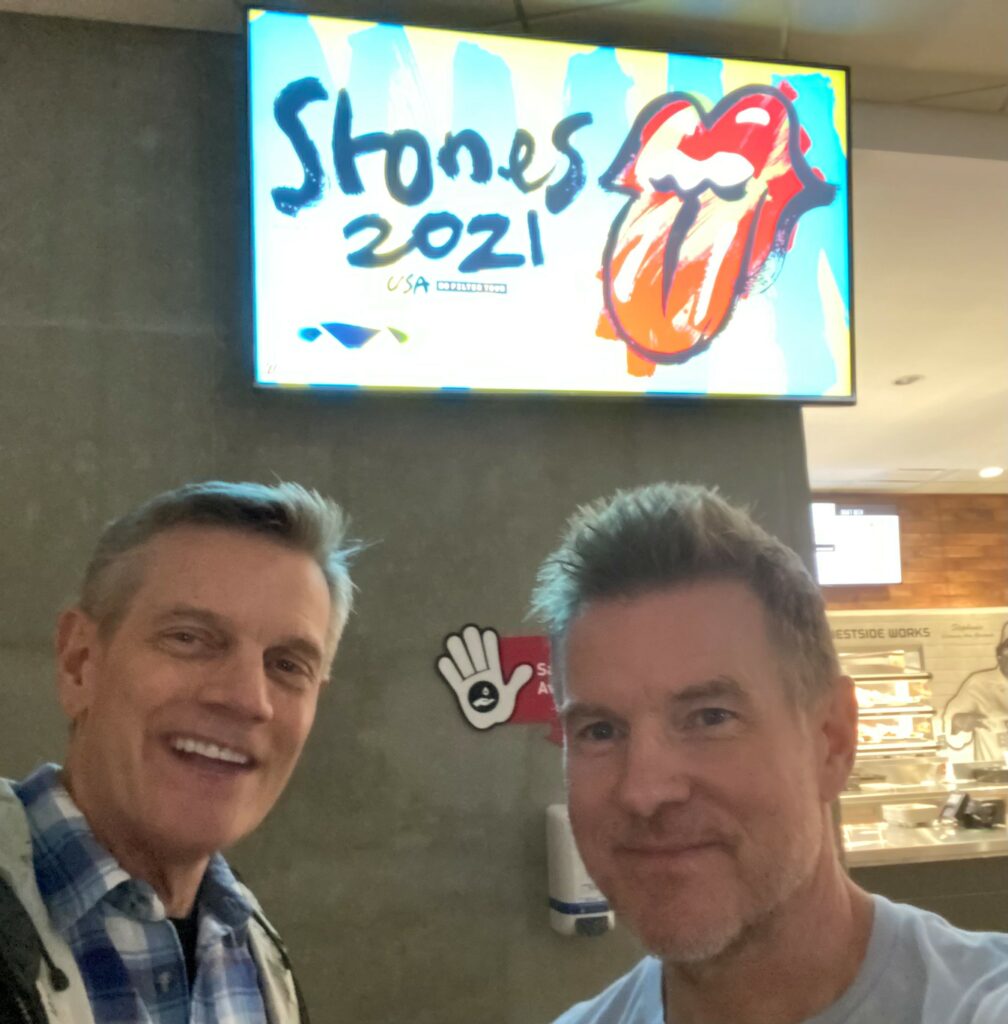
40 years later, on Veterans Day, 2021, Jeff and I decided to re-live the magic by closing the circle and seeing the Stones together again, this time at a slightly larger arena—Mercedes-Benz Stadium in Atlanta. This was my 11th Stones show, the 5th in Atlanta.

This was the first show I would hear without beloved Stones drummer Charlie Watts. He’d been with the band since January 1963, and until their first show on the current tour the Stones had never played a gig without him in 59 years. How do you replace the irreplaceable? Not to mention—but I’ll mention it anyway—Mick Jagger is now 78, Keith Richards is 77, Ronnie Wood is 74. Isn’t this supposed to be a young person’s game? The Wembley Whammer was fittingly remembered just before the show with a video tribute on the gigantic screens that tower over the stage.

Not to keep you in suspense, but the Stones—and I would call them “the surviving Stones,” but with these guys that’s been true since the death of Brian Jones 52+ years ago—were as good as it gets. Better than ever. Maybe even better than that. How is that possible? From the opening and unmistakable chords of “Street Fighting Man” through the buzz-bomb bass notes of “19th Nervous Breakdown,” through “Shattered,” (shadoobie) and “Satisfaction” the Stones did what they do and that no one else can.

After nearly 60 years, they still set the gold standard. Mick ran and pranced and “wiggled his bum,” as Charlie used to say. Keith wore a beanie throughout like the Grand Old Ghoul of Rock n’ Roll that he is, playing louder than ever, smiling and loving every minute. Ronnie was Ronnie. They even threw in 1967’s “She’s a Rainbow” (from Their Satanic Majesties Request), allowing Chuck Leavell to showcase his keyboard chops. Steve Jordan on the drums brought an energy and vibe that honored Charlie Watts while putting his own unique stamp on the music. They are still playing with an energy and a love for performing that defies reason. Like every other Stones concert I’ve witnessed across four decades, I didn’t want the music to end.

Seeing the Stones 40 years ago was already, at that time, seeing history. The Beatles had been broken up for a decade and John Lennon was dead. Led Zeppelin had dissolved two years earlier. Elvis had been gone for 4 years. Other founding acts of early rock had already long since vanished or gone into hibernation.

The Stones rolled on, aging but never growing older, continuing to play, dismissing the critics, and with every passing decade they passed milestones that seemed impossible. Touring at 50 in the 1990s? Ridiculous. Having another go at 60 in the early 2000s? They’ll embarrass themselves. Are they really going out on the road at 70, in the 2010s?? What will they call it, the Walker Tour? The Roller Derby?

Now they’re approaching 80, and are at a place no band has ever reached. No one now even remembers the British invasion, but watching the Stones is to remember the shock of their early appearance with long hair, their surly attitudes and rebellious sneers, and their anti-establishment pose. They still have something to prove, and they clearly enjoy trying to prove it.

It’s bound to end sometime, isn’t it? Surely Jeff and I won’t be seeing them again in 40 years—or even 5. But as we walked out of the arena, there on the big video screen was a message from the Stones that—true to form for them—teased and tantalized, but that I fervently hope was true:

“See you soon.”

Steal Away Home

The baseball season ended Tuesday night in the most improbable way imaginable. Our Atlanta Braves won the World Series. I honestly didn’t think I might ever see those words again. It’s been 26 years since, midway through my graduate years at the University of Florida, I watched them beat the Cleveland Indians 1-0 to claim their first title in Atlanta. That long-ago October evening has faded to a distant memory, but not the pain of losing the next year after going up 2-0 in the Series against the hated Yankees, only to lose the next 4 in a row. The Braves never really came close to winning it all again. Until now.

I don’t need to recount to Atlanta and UGA sports fans the dangers of counting championships before the game or series is completely over. And I won’t do it here. But when the last out was recorded on Tuesday night, Dansby Swanson to Freddie Freeman, the overwhelming emotion I felt was one of relief. Other fans I’m sure can relate without any explanation needed.

This Braves team will obviously always be special. Unlike the 1995 team, no one predicted them to win anything, except perhaps the National League East again. By mid-season their underperformance made even that unlikely. The story of the mid-season acquisitions at the trade deadline that remade this team has been told and re-told elsewhere. Their winning without ever seeming as if they possibly could is part of the greatness of this year. The season felt like it was put together with duct tape and baling wire.

But for me, this year’s edition of the Braves is special for another reason entirely. This was the last Braves team that my father—a Braves lifer—ever watched. He died peacefully at his home on Sunday, September 5, a month from his 89th birthday, quietly drifting away as “the sun gradually wheeled his broad disk down into the west,” as Washington Irving so eloquently put it.

In the last month of his life, my father stopped watching his favorite TV shows; he stopped reading his Westerns; he stopped following the news. The only thing that he didn’t put away as he prepared to go was his love for the Braves. They were on and winning—9-2 against the Colorado Rockies—on the afternoon that he died.

That these Braves would go on to win the big prize in the same autumn as his death seemed cruel and yet somehow poetic. Each step that brought them closer to the summit—from Freddie Freeman’s improbable home run against Josh Hader and the Milwaukee Brewers, to Eddie Rosario’s game-winning homer against the Dodgers, to his impossible catch in Game 4 to put the Braves up 3-1 against the Astros—confirmed that something magical and yet mystical was happening right before our eyes. The Braves weren’t doing this alone. As I mourned my father missing it all, I sensed that he wasn’t missing a thing. As one reporter noted after Rosario’s game-saving catch, there seemed to be angels in the outfield.

Baseball’s passing every year brings a sadness with it, but this season’s end brings more melancholy than usual for me. This year’s Braves will always be the last upon which my father’s eyes rested.

Baseball will come back in the spring. It always does. There will be new prospects and predictions and expectations. In the new season, any team, at least on Opening Day, might be champion.

But something will be missing next Opening Day. The irreplaceable man who taught me how to throw and hit a baseball won’t be there to see it.

He had, throughout his life and especially in his final days, “the capacity to wear glory with grace,” as Jesse Jackson so movingly said in his eulogy of Jackie Robinson. For me, this championship season will be forever linked to my father who, just as the leaves began to change and the days grew shorter, stole away home, and, like the Braves, ascended to glory.

I bet he had the best seat in the house.

Q&A: Reading and Writing with Michael Van Wagenen

Dr. Michael Scott Van Wagenen is associate professor and public history coordinator at Georgia Southern University. He is the author of the award-winning, Library Journal best seller Remembering the Forgotten War: The Enduring Legacies of the U.S.-Mexican War (University of Massachusetts, 2012), The Texas Republic and the Mormon Kingdom of God (Texas A&M, 2002), as well as several articles and book chapters. He is also co-editor with W. Paul Reeve of Between Pulpit and Pew: The Supernatural World in Mormon History and Folklore (Utah State University, 2011). In the past 30 years, he has written, produced, directed, and/or edited over 20 documentary films. His work has twice won highest honors at the National Education Film and Video Festival and been screened at the American Museum of Natural History, the Smithsonian National Museum of Natural History, Margaret Mead Ethnographic Film Festival, Chicago Latino Film Festival, and several other venues. Dr. Van Wagenen received his BA from Brigham Young University, an MAIS from the University of Texas at Brownsville, and his PhD from the University of Utah.

What first got you interested in history?

When I was very young my grandfather would tell me stories about his experiences as a Navy officer in the Pacific during World War II. That definitely sparked an awareness in me that there was this adventurous place called “the past” that you could visit through stories, books, museums, and films.

What kind of reader were you as a child? Which childhood books and authors stick with you most?

The first book I read was an “abridged for young readers” edition of Robinson Crusoe. I was in first grade and binged it all in a day. I was hooked on historical fiction and non-fiction after that.

What book did you read in grad school that you never want to see again—and what book was most influential?

I studied folklore to enhance my understanding of history and really struggled with Roland Barthes’ Mythologies (1957). I’m sure it was me, not him. On the other side of things was Michael Kammen’s Mystic Chords of Memory: The Transformation of Tradition in American Culture (1991). I couldn’t put that book down, and it really inspired my interest in the theories of collective memory.

What’s the last great book you read, fiction or non-fiction?

It’s a bit of a local cliché, but I finally got around to reading John Berendt’s Midnight in the Garden of Good and Evil this summer. I loved it—much better than the film.

You’re a documentary filmmaker: what movies and documentaries most inspired you when you were young? What filmmakers?

I don’t really remember watching documentaries as a kid. I watched a lot of old war movies and historical dramas on television: The Thin Red Line, Beau Geste, and Nicholas and Alexandra come immediately to mind. I also loved the satirical war television series F-Troop and Hogan’s Heroes. As far as filmmakers go, the first director I can remember being aware of was Akira Kurosawa. In high school in Los Angeles, I would go to the art house theaters to watch his films. Toshiro Mifune was my original action hero.

When you’re not reading for your particular field of history, what else do you like to read? What genres do you avoid? And what’s your guilty reading pleasure?

I am a complete sucker for a beautifully illustrated coffee table book. I have my own large collection of folk art books that I read and reread—my guilty pleasure, I suppose. As far as what I avoid: definitely self-help/motivational. Anyone who thinks they have the answer likely doesn’t.

What do you read—in print or online—to stay informed?

I consume it all, from left to right. I like to make my own decisions about things after I have read or listened to as many perspectives as I can. As you can guess, my politics are confusing to most people.

Describe your ideal reading experience (when, where, what, how).

As a kid I visited my grandparents who were staying on a secluded part of the California coast. We were hit by a big storm with lots of wind, rain, and pounding waves for a couple of days. There was no television or radio—just a blanket, a lamp, and a stack of pulp westerns to read. I know I’ve romanticized that moment, and I have tried to recreate that environment over and over with no success. Hurricane season is not through yet this year, so who knows?

What’s your favorite book no one else has heard of?

The Giant Joshua by Maurine Whipple (1941) is a historical fiction novel about Mormon polygamy in the mid 1800s. While it made a modest literary splash when it came out in 1941, it is largely forgotten today.

What book or collection of books might people be surprised to find on your shelves?

I have a small collection of books about UFOs. I was raised during the new-age UFO revival of the 1970s, so that shaped my childhood. I have actually published on historical UFOs and will likely develop a class on them. My approach to UFOs is similar to that of Carl Jung, who viewed them as another way to interpret the values and beliefs of a people.

How have your reading tastes changed over time?

Sadly, less MAD Magazine.

Disappointing, overrated, just not good: What book did you feel as if you were supposed to like, and didn’t? Do you remember the last book you put down without finishing?

Grasshopper Jungle (by Andrew Smith, 2014). I like a good young adult fiction book, and this one was widely praised and loved. I guess my own childhood was too urban, too undersexed, too lacking in actual alien encounters for me to connect with it.

What book would you recommend for America’s current moment?

Don’t Bite Your Friends by Lisa Rao (2009).

What do you plan to read next?

My daughter is a professional writer, and she just sent me her latest manuscript. I’m thrilled to be diving into that one!

What is the next book or article you’re going to write?

I am putting the finishing touches on an article titled “Mormons, Memory, and the Mexican War: The Role of Mormon Battalion Commemoration in the Formation of Latter-day Saint Identity, 1921 – 2021.” I use as a case study the United States’ only religiously segregated military unit to explore how collective memory and identity are constantly evolving to serve a number of social, political, and religious agendas. What’s next after that? I am writing an article about a Mexican folk art particular to the Otomí people of central Mexico. Between the early nineteenth and early-twentieth centuries they created a particular style of crucifix, called a cruz de ánimas, that they venerated to end their ancestors’ suffering in purgatory. These artifacts serve as a preliterate genealogical pedigree, and very little has been written about them.

When and how do you write?

Mornings and nights are best for me. There are too many distractions during the day. I am one of those people who need large blocks of time to find my focus.

With which three historic figures, dead or alive, would you like to have dinner?

I have three immigrant ancestors: one Dutch from the 1600s, one Irish from the 1700s, and one Scottish from the 1800s, who I would love to meet. I would cook Tex-Mex food and ask them so many questions that they would be begging to crawl back into their graves!  

Joy in Mudville

Oh, somewhere in this favored land the sun is shining bright,
The band is playing somewhere, and somewhere hearts are light;
And somewhere men are laughing, and somewhere children shout,
But there is no joy in Mudville—mighty Casey has struck out.


“Casey at the Bat,” Ernest Lawrence Thayer, 1888

Six months ago, on April 1, I welcomed the start of the baseball season, and now the Braves have made it to the National League Championship Series, the semi-finals of the World Series.

They made this trip 8 years in a row between 1991 and 1999, winning 5 National League pennants, returned in 2001 (losing 4 games to 1 to the Arizona Diamondbacks), then had a 19-year drought before returning to the NLCS in 2020 in a pandemic-shortened 60-game season. They led the eventual champion Dodgers 3 games to 1 before losing three straight to hand them the pennant. Will this year be different? As of this writing, they still await their opponent—either the San Francisco Giants or the Dodgers again.  Either team will present a huge challenge.

The 2021 MLB playoffs have already had some very strange moments. I’ve been watching baseball for 50 years but I’ve never seen a play like we saw in Game 3 between the Red Sox and the Rays last Sunday. With the score tied 4-4 in the 12th inning and the go-ahead runner on first base, Tampa’s Kevin Kiermaier hit a deep fly ball to right field. Everybody knows about Fenway Park’s 37-foot Green Monster in left field, but the fence in right is only 3 to 5 feet tall.

The ball hit the top of the fence, caromed back onto the field, hit Boston right fielder Hunter Renfroe, and then bounced over the short fence and out of play, which otherwise would have easily scored Yandy Diaz, the Tampa runner at first. After the umpire’s conferenced with each other and then talked to the replay booth in New York, the play was ruled a ground-rule double, sending the go-ahead run back to third base and stopping Kiermaier at second. Outrage and dismay rang out loudly across the Twitter-verse. The next batter struck out and Boston’s Christian Vasquez hit a walk-off 2-run homer in the bottom of the 13th, ending a game that lasted 5 hours and 14 minutes and featured 16 pitchers.

Would that Tampa run have made any difference if Diaz had been allowed to score? Who knows, but that extraordinary and bizarre play encapsulates what is so great about baseball:  even after 150+ years of baseball history, the game can show you something new every night. And it demonstrates the uniqueness of the game. Think about this: every professional ice hockey rink has the same dimensions, as does every NBA basketball court, and every football field, whether at the high school, college, or pro level. But every baseball field in every stadium in major league baseball has different dimensions in terms of the distances between home plate and the outfield fence, and as regards the height of the outfield fence. A ball hit in Fenway Park will not play the same as a ball hit to right field in Dodger Stadium. That’s the charm and the lunacy of this game.

Don’t get me wrong, I love the old historic ballparks as much as the next person, but it’s a shame to see the park itself determine the outcome of a game. That wouldn’t have happened in a more modern ballpark with taller fences.

Then, in Game 3 of the Giants-Dodgers series on Monday night, with the Giants leading 1-0, a strange wind blowing over Dodger Stadium in Los Angeles knocked down a potential game-tying 9th-inning home run off the bat of Dodger Gavin Lux. The same hit would have been out in nearly every other park, but it dropped dead that night in LA and ended the game. Giants win, 1 – nil.

In the 4th inning of the Braves clinching Game 4 win Tuesday night in Atlanta, Adam Duvall hit a pop-up behind home plate that deflected off Brewers catcher Omar Narvaez’s glove before being caught by third baseman Luis Urias in what looked like a great heads-up play. But replays showed the ball hit the ground before Urias caught the ball, which should have extended Duvall’s at-bat.

Everyone—especially Braves fans—waited impatiently for the play to be overturned on review. But—Sonja Henie’s tutu!!—the play turned out to be un-reviewable by the umpires. Why? According to MLB: “An umpire’s decision whether a fielder caught a fly ball or a line drive in flight in the outfield before it hit the ground is reviewable, but fly balls or line drives fielded by a defensive player in the infield is not eligible for review.”

A play like that is not reviewable, in Game 4 of the playoffs with both teams’ season on the line? Why? What is the point of having replay if not for moments like that? To quote Dr. Clipton in Bridge Over the River Kwai: Madness.

Finally, there was the bizarre base-running interference play in Game 3 of the Astros-White Sox series on Sunday night that I won’t even begin to describe. But if anyone can adequately explain MLB’s rules to me on what does and what does not constitute baserunner interference, dinner at the Burp n’ Slurp is on me.

These kinds of strange plays happen frequently throughout baseball’s long 162-game season without attracting much notice. If you lose tonight, you play again tomorrow night. Repeat that sequence for the next six months. But suddenly in a short playoff series these missed calls and freak plays can end your season and championship dreams quickly.

That’s always been the most maddening and yet intriguing part of the MLB playoffs to me. Baseball plays the longest season of any professional American sport, at 162 games. Across that long span we know who the best teams are in both leagues. There’s no guesswork involved. This year the San Francisco Giants won 107 games, and they are clearly the best team in the National League, just as the Tampa Bay Rays with their 100 wins are the American League’s champs. In a normal universe, these two teams would go straight to the World Series and play each other for the championship.

But that’s not the way it works in Mudville. Here, the post-season tournament starts, and all of that is thrown out. Madness begins. Eight teams make the tournament and anything can and does happen. In a short series, good hitters bats go cold; Cy Young-winning pitchers can’t find the strike zone. Relief pitchers who haven’t lost a game since Hector was a pup give up game-winning home runs. Controversial plays aren’t reviewable, the wind knocks down a game-tying home run, a ball hits a player and bounces over the fence, and your season comes to a crashing halt. Teeth gnash and grown men and women wail.

Former baseball commissioner and Yale president Bart Giamatti was right: baseball breaks your heart. It is designed to break your heart.

But just when all hope seems lost, Mighty Casey, in the fine form of Freddie Freeman, steps to the plate against one of the best relievers in baseball—who hasn’t given up a run in almost two months—and he does not strike out. Instead, he crushes a game- and series-winning tater over the wall, sending the faithful into a furious frenzy. Joy in Mudville.

Who knows what heartache may await in the next round, or in the World Series? For some team, it will surely come.

Let it. That’s what this great game is designed to do. God, how I love it.